Saturday, March 30, 2019

Us (2019) *

Image result for Us movie pics

Directed by:  Jordan Peele

Starring:  Lupita Nyong'o, Winston Duke, Elisabeth Moss, Evan Alex, Shahadi Wright Joseph, Tim Heidecker

Us plays like a Twilight Zone episode stretched out to an interminable length.   After the runaway success of his Get Out, Jordan Peele's previous film which netted him a Best Original Screenplay Oscar, we now have Us.   If this movie is any indication, Peele is a one-hit wonder.    Critics have hailed Us as another Peele masterpiece.    Get Out was an amusing horror comedy with social commentary thrown in.    Very entertaining, yes.   Masterpiece, no.    Peele doesn't even approach entertaining here.

You can read my review of Get Out elsewhere on this blog.    I will tread carefully with my plot recap so as not to reveal spoilers, but maybe I would be doing you a service by revealing such plot points.   But, I won't.   It isn't my duty to tell you how to spend your hard-earned money at the movies.    Us begins in 1986 Santa Cruz.    A television ad for Hands Across America plays.    For those unfamiliar with Hands Across America, it was a semi-successful attempt to create a human chain holding hands from coast to coast to raise awareness and money to fight hunger.    We Are the World it wasn't, and it came at a time when America was ready to move on from such songs.   

A young girl named Adelaide wanders away from the Santa Cruz boardwalk while her father was playing Whack-A-Mole and finds herself in a house of mirrors where she comes face to face with a doppelganger.   The encounter has a negative effect on Adelaide for a while, as it renders her unable to speak or communicate her fear.    We move to the present day, with Adelaide (Nyong'o) married to a stable guy named Gabe Wilson (Duke) and mother to two young children, Jason (Alex) and Zora (Joseph).    They are one night into their vacation getaway at their wilderness home when Adelaide sees a family standing menacingly in the driveway.   There is a wife, a husband, and two children, all wearing red.   When they break into the house and hold the Wilsons hostage, we see they are a family of violent doppelgangers who wish to murder their counterparts.  

Us then becomes a high-concept slasher film with people being offed in bloody, brutal slayings.   It turns out the Wilson isn't the only one with their own set of doppelgangers.    Their friends (Moss and Heidecker) have their own group of look-alikes to fend off, which they do with less success than Adelaide and company.   The entire Santa Cruz area is besieged by red-clad evil twins and after killing their targets, they hold hands to form the human chain a la Hands Across America.    Soon, we learn of the diabolical reason for the doppelgangers' existence, which involves the alleged thousands of miles of abandoned tunnels underneath the nation and scientists who wanted to make clones to, what, ensure Hands Across America is fully realized 33 years after its first attempt?

I simply shake my head.   What else can I do?    Us isn't scary, funny, or involving.   The Wilsons aren't fleshed enough for us to care about why they are being targeted, or why we should want them to succeed in killing their evil clones.   The plot is explained, but the explanation hardly enlightens. Critical reviews of Us have been mostly glowing and genuflecting, crediting Peele with providing racial and oppression subtext which frankly isn't present, no matter how much you want it to be.    Sometimes film critics can be as pretentious as art critics who look at a painting and attempt to bestow upon it some bogus significance.   They simply can't admit they don't know what the hell they're looking at either.    Peele is such a hot commodity now that nearly anything he pitches will be made.   I shudder to think of what that will mean in my movie-going future.

Friday, March 22, 2019

The Inventor: Out for Blood in Silicon Valley (2019) * * *

The Inventor: Out for Blood in Silicon Valley Movie Review

Directed by:  Alex Gibney

Featuring:  Elizabeth Holmes (archive footage)

If it sounds too good to be true, it usually is.   This well-worn phrase is still relevant because people continue to fall for the next great idea which will enrich humanity and make them stupid money at the same time.    Elizabeth Holmes had such an idea at age nineteen and by the time she was in her early twenties, she founded a tech company in Silicon Valley with powerful men such as Henry Kissinger and George Shultz as investors.    How did a Stanford dropout convince wealthy power brokers to fork over millions to fund her company and her ultimately fraudulent dream?    You would think such players would be leery of a young woman (or man) pitching them ideas of a small black box which would be able to perform hundreds of blood tests with just a tiny sample of blood.    This was Elizabeth's idea and she called it The Edison.    The Inventor illustrates why this is such a fitting name for her doomed product.

Thomas Edison was, of course, among the most famous inventors in all history.   He patented many inventions which would change the world, but he was just as notorious for stalling investors who were impatient to see what they invested in.    In the case of the incandescent light bulb, Edison was near the end of his financial rope with investors threatening to sue him for fraud when he finally got it right.   Elizabeth Holmes treated her vision the same way.    Her art was to fake it until you make it. 
The Edison sounded like a noble, efficient product which could change the blood industry.    Until her company Theranos was founded, Lab Corp and Quest Diagnostics ruled the blood testing landscape.
They did it the old fashioned way, by sticking a needle in your arm and drawing vials of blood.
The Edison promised to perform the same tests with just a pinprick of blood.    Never mind that Elizabeth had no medical background and doctors she consulted early on told her such an invention couldn't possibly work, she steamrolled ahead by gathering investors, nearly 800 employees, and a flashy new office in Silicon Valley.    By 2014, Theranos was valued at $9 billion even though the company did not produce a single working Edison. 

Pyramid schemes work because people want to get rich quick.   They fall for the package and trust the con artist far too quickly.   I have no doubt that Elizabeth had a dynamic vision for the future, but when it became apparent her machine would not work, she committed fraud by using standard lab testing equipment to test the blood samples The Edison was supposed to test.    A lucrative deal fell through with Walgreens when they ran out of patience as Theranos couldn't deliver on its promises while customers complained that it took weeks to get results which turned out to be dubious at best.
Through it all, Elizabeth remained stout, determined, and unflappable even in the face of damaging Wall Street Journal articles and government crackdowns on Theranos.    The more scrutiny she faced, the more she buried herself in lies.    Theranos is now defunct, and she and her business partner/lover
Sunny Bulwani are now facing up to twenty years in prison on numerous fraud and financial charges.  Her net worth is now zero, which is the least of her problems.

Alex Gibney's most famous documentaries involve masters of deception who sold people on their visions and then intimidated those who blew the whistle on them.    His subjects include Enron, Lance Armstrong, The Catholic Church, and now Elizabeth  Holmes.    Each succeeded temporarily in selling a dream and a story to those they ultimately victimized.     They had money, power, and enablers who helped them cover up their crimes, or those who naively bought into the deception in the first place.    Elizabeth herself is a beautiful enigma.    She has intense eyes, dresses in all black outfits eerily similar to those Steve Jobs wore, and speaks in a confident baritone.    Her voice lent her credibility she hadn't earned at the age of twenty.    If Elizabeth had spoken in a higher pitched, more feminine voice, maybe her investors wouldn't have taken her as seriously.    She would've sounded like an airhead with a farfetched dream.    But she sounded and looked the part of a serious inventor, and people bought in.    This persona allowed her to keep her investors' and board's confidence much longer than she should have had it.    Elizabeth was overpowering, empowering, intelligent, focused, confident, and very easy on the eyes.   Who exactly was at home behind her sometimes seemingly unblinking eyes?   No one really cared to find out.   She sold a bill of goods, and many bought it.

Numerous former employees and colleagues are interviewed, as well a New Yorker reporter whose cover story helped launch Elizabeth's celebrity.    She rubbed elbows with Barack Obama, Bill Clinton, Joe Biden, Serena Williams, and many other famous people who were in awe of her, instead of the other way around.    Gibney doesn't let it go unnoticed that without the financial backing of such power players, Theranos would have not existed.    They fell for the package of Elizabeth Holmes while failing to notice her sleight of hand.    They saw what they wanted to see, and never peeked inside the box. 

Gibney's best documentary remains Mea Maxima Culpa: Silence in the House of God (2012), because The Catholic Church's culpability was evident as they covered up abuse by priests for the sake of keeping money flowing to their coffers.   The most powerful moment in the film is a group of deaf adult males using every ounce of their limited communication skill and repressed anger they have to confront the priest who abused them decades before.   The Inventor never reaches that level of intensity and drama.    Those who were victims of Elizabeth's fraud and intimidation by her legal team (a la Lance Armstrong when others tried to speak out on his steroid use) do not get the chance to directly face their perpetrator.    She will have her day in court, and her comeuppance will come at the hands of the legal system, but she remains not much different than the leaders of Enron or Lance Armstrong.   They, like Elizabeth Holmes, sold a vision and a version of themselves to the public and found they were willing to break the law to protect that vision and the face they wanted everyone to see. 


Tuesday, March 19, 2019

The Running Man (1987) * * *

Image result for the running man movie pics

Directed by:  Paul Michael Glaser

Starring:  Arnold Schwarzenegger, Richard Dawson, Maria Conchita Alonso, Jim Brown, Yaphet Kotto, Jesse Ventura, Mick Fleetwood, Erland von Lidth, Professor Toru Tanaka

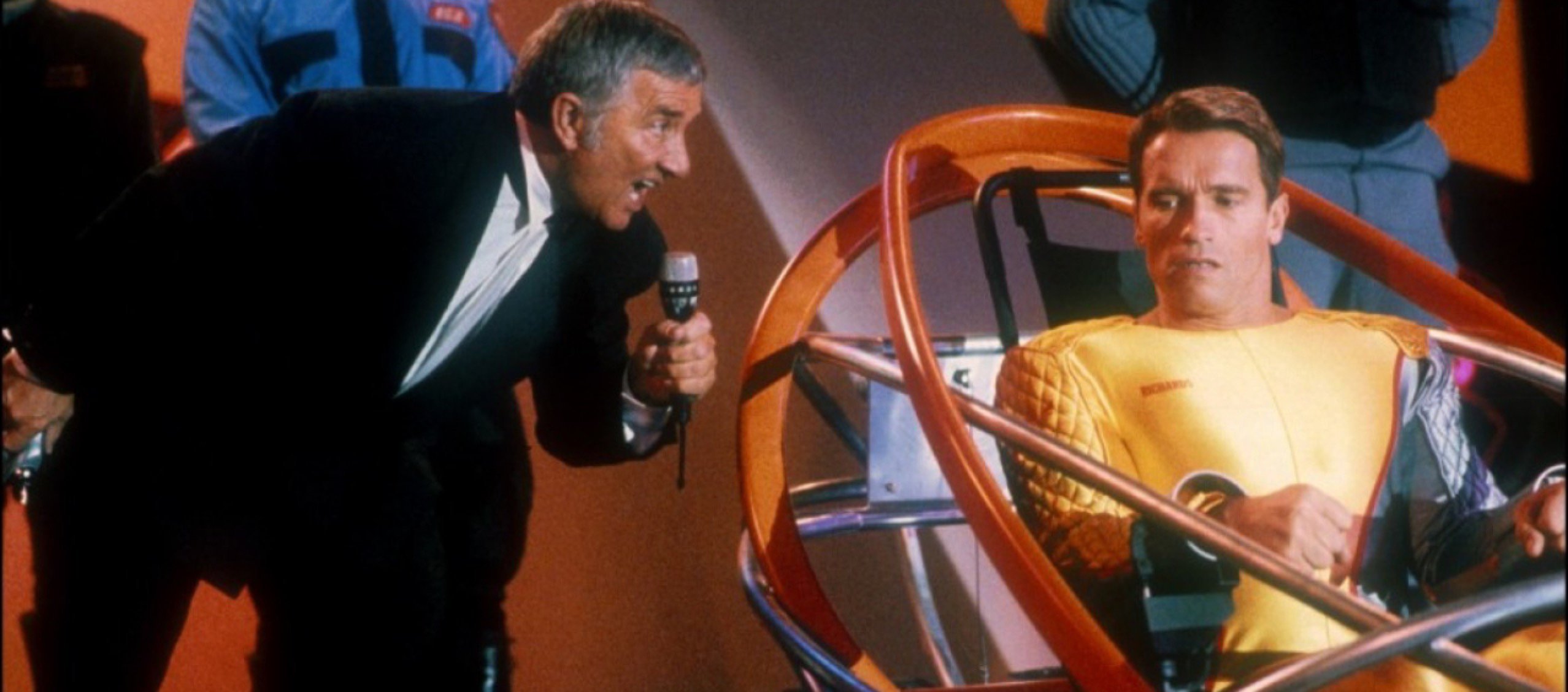
The Running Man is set in a bleak, totalitarian futuristic society of 2019.   The favorite program on state-run television is The Running Man, in which convicts battle sadistic killers called "stalkers" on live TV.   If the convicts win, they are granted their freedom.   If they lose, well, they die.   The network manages to find ways to ensure the convicts don't win.    For the record, it is 2019 now and the country doesn't look anything like the dark, foreboding society depicted here thirty years prior.    We aren't a totalitarian state yet, although if the President has his way maybe that will change (kidding--sort of).   It would be refreshing to envision a future which is a lot like the present, with maybe a few more newer, cooler cell phones. 

The Running Man is one of the many 80's Arnold Schwarzenegger films which were turn-your-mind-off joys to behold.    They didn't make a lot of sense, even while you were watching them, but you'll have a pretty darn good time for the ninety or so minutes they last.   And they were anchored by Arnold Schwarzenegger, pre-California governor mode, who threw punches, kicks, and one liners with equal zeal.    He was an action star with a sense of humor about himself and the material he was starring in. 

In The Running Man, Arnold is Ben Richards, a state cop framed for murdering civilians after he refuses to fire on them from his helicopter.    He is thrown into a prison where the inmates break apart rocks in a chain gang, and manages to escape.    But, he is soon apprehended at the airport, and sentenced to be this week's contestant on The Running Man, produced by and hosted by the sleazy, sadistic, and selfish Damon Killian (Dawson).    Before you simply assume Dawson is riffing on his Family Feud hosting gig, let's not forget he was a character actor long before taking over that job.    He is convincing as an oily game show host who schmoozes up to the audience shamelessly while introducing which stalker will be sent out to off Richards.    We hope he gets his just desserts, and if he doesn't, we are simply watching the wrong movie.

Richards and his cohorts from prison, plus a network worker (Alonso) who turned in Richards at the airport, but suspects he may be innocent, are all thrown into the game to battle the baddies who all use deadly weapons with glee.   One has a hockey stick which decapitates people, one a flamethrower, one a chainsaw, and one who likes to sing opera before decimating his victims.    It is not a spoiler alert to suggest they meet their fates in gruesome ways.    It is also not a spoiler to state that the audience which vociferously cheered the stalkers soon find themselves cheering for Richards, even without knowing he is actually an innocent man.    Arnold and pal Sly Stallone were always trying to playfully one-up each other in their movies back then.    Maybe this was Arnold's way of trolling Sly for the audience's about-face in Rocky IV.    Or maybe I'm putting way too much thought into this. 


Sunday, March 17, 2019

Baby Boom (1987) * * *

Primary babyboom1

Directed by:  Charles Shyer

Starring:  Diane Keaton, Sam Shepard, Sam Wanamaker, James Spader, Harold Ramis, Victoria Jackson, Pat Hingle

Baby Boom was released so long ago, the high-powered advertising executives didn't have, gasp, computers on their desks.    They got the work done, but it is disconcerting to see all of those papers flying around the office.    In many ways, Baby Boom is like a time capsule of the 80's yuppie culture, with J.C. Wiatt (Keaton) as the yuppie executive who works "from 5 to 9" and whose relationship with her live-in boyfriend (Ramis) has all the spark of a burned-out light bulb.    J.C. is on the fast track to a partnership at the advertising firm where she essentially lives, but then her British cousin dies and bequeaths her with a toddler named Elizabeth, who is irresistibly cute.

J.C. isn't the motherly type at first, and wants nothing more than to have this child out of her way, but just as Elizabeth is ready to be adopted by stern, no-nonsense farmers who want to name her Fern, J.C. decides to keep the kid and try and juggle her newfound motherhood with the high demands of her career.    Her boyfriend moves out shortly after she decides to keep the baby.   Her boss Fritz Curtis (Wanamaker) isn't exactly sympathetic.   ("I don't even know how many grandchildren I have, but I have this firm making $200 million a year,")   With a younger, childless, male upstart (Spader) slowly usurping J.C.'s power at the office, she soon finds herself without a job and moving to a rustic country house in Vermont.

It isn't a terrible thing to lose your job and have enough cash on hand to buy fifty acres in rural Vermont, but J.C. finds she can't handle the quietness.    Her house is falling apart and her well is drying up.  The only available man under sixty in the whole county is the affable veterinarian Dr. Jeff Cooper (Shepard), who likes J.C. in his own aw-shucks, charming way.    But, she wants out of Vermont and finds a way to do so by marketing the applesauce she made during the long boring days in the country.

Diane Keaton is not the first person who springs to mind when the words "determined career woman" are uttered, but because she is an actress of limitless appeal, she of course makes it work.    Baby Boom isn't a hard-boiled look at careerism vs. parenting.   In J.C.'s case, she winds up having it all, even though Fritz tells her she can't.   Many women of lesser means likely can't say the same thing. 
Baby Boom is a charming, sweet comedy in which J.C. transforms from career-obsessed to parenting-obsessed over the course of 100 minutes.   It scratches the surface of the issues it brings up, but doesn't delve too deep.    Her climactic speech in a board room of executives interested in purchasing her fledgling applesauce company takes a stand for women who want to have it all, but I don't know.... that compensation package didn't sound half bad. 

Captive State (2019) * *

Captive State Movie Review

Directed by:  Rupert Wyatt

Starring:  John Goodman, Ashton Sanders, Kevin Dunn, Vera Farmiga, Alan Ruck, Jonathan Majors

Captive State shoots out of the gate so fast it leaves our ability to care behind.   Characters are introduced and pressed into action before we've had a chance to gain our footing, and we witness people running around and doing important things without letting us in our what they're doing.    So for the first ninety minutes, we have to decipher what is happening and why.    We know the basic gist:   Ten years ago, aliens invaded Earth and brought the world's governments to their knees.   The governments agree to surrender all power to the aliens in exchange for the lives of their people.   The aliens live underground and legislate, while leaving the police above to handle the dirty work and suppress any attempted rebellions.    These aliens are pretty hands-off when it comes to occupying a conquered planet, and while the aliens aren't seen that much, their presence is felt in the ruins of what was once Chicago. 

The aliens set up "closed zones" in each major city, which is where the aliens hang out and people work beneath the surface to mine natural resources.    So, the aliens want us to do what we've already been doing at an alarming rate without their leadership for decades now anyway?   No matter.   There is a rebellion on the horizon, led by Gabriel (Sanders) and a group of others who aren't even named until a helpful recap near the end courtesy of Chicago cop William Mulligan (Goodman), whose job it is to squash the rebellion.   Gabriel's father (we see him obliterated by the aliens in the film's opening sequence), used to be Mulligan's partner, and Mulligan feels some sympathy towards the young man, but not enough to stop from performing his duties.

Knowing John Goodman as we do, we know Mulligan isn't totally evil because he's played by John Goodman, who can't help but be likable even when he's being a dick.    The other characters are pretty non descript.   They are cogs in an ever churning plot which fails to keep us compelled.    The aliens themselves look like giant, biped porcupines, which is great when you are designed to kill things, but not so great if you want to do anything else with your day.   How do these aliens cozy up to their loved ones with these metal quills sticking out all over?   Am I the only person who thought of this?

There is business about tracking implants, undetectable bombs, and aliens' apparent aversion to modern technology.    We see electric typewriters, pay phones, actual newspapers, and dial-up modems in use.    Are these aliens like the people on Facebook who post complaints about how awesome it was to grow up in the 80's because you didn't have cell phones?   (My answer:  I would've loved to have cell phones back then, but I made do because I didn't know any better).    It is never quite explained why, in 2026 (which is when the movie takes place), offices and homes have reverted to old school technology.

Once the plot is helpfully explained and we understand the scope of it, the movie perks up a bit and gathers momentum in the final ten minutes.   But then, Captive State ends just as it's getting started, and we realize how the first ninety minutes were such a waste.    If the filmmakers think we would have enough goodwill to sit through Captive State II to find out what happens, well they have another thing coming.


Friday, March 15, 2019

Five Feet Apart (2019) * 1/2

Image result for five feet apart movie pics

Directed by:  Justin Baldoni

Starring:  Haley Lu Richardson, Cole Sprouse, Moises Arias, Kimberly Hebert Gregory, Claire Forlani

Five Feet Apart wants to be a tearjerker romance about two people unfortunately stricken with cystic fibrosis (or some form thereof), but how am I supposed to care when I'm baffled by how absurd it is?
Stella (Richardson) and Will (Sprouse) are appealing enough, but how are they able to have virtually unfettered access to every square inch of the hospital where they are forced to stay?    The movie loses all credibility because the director wanted to continually find new places for these two to hold conversations.    It can't be good for your condition to be ultimately wandering around outside in the cold for miles on end.

Stella has had cystic fibrosis since birth.   She is once again hospitalized awaiting a lung transplant with no guarantee of success.    She sticks to her medication regimen and documents her fight against the disease on her YouTube channel.    Her best friend Po (Arias) is a sweet, frail guy who is also gay.   Brooding, pessimistic Will soon enters the hospital to undergo clinical trials for his more advanced disease which is even more contagious than cystic fibrosis.    The ward's attending nurse (Gregory) insists the two remain six feet apart at all times in order to lessen the chance of airborne contagions.    She apparently isn't as concerned with the two would-be lovers running all over the hospital unattended.   

They are at first combative, but soon fall in love and Stella takes a stand.    She wants the two to risk it all by remaining five feet apart at all times instead of six.    They take back a foot, as Stella puts it, and therefore they are saying f*** you to their circumstances.    Fair enough.    They walk around practically undisturbed in all areas of the hospital, even the roof.    They keep a pool cue between them to maintain their distance, physically if not emotionally, and I kept wondering where the pool cue came from.    Did Stella raid the doctor's lounge and steal it from a pool table, if there is one?

This hospital is a lawsuit waiting to happen.    They seem to have only a handful of staff, and in only one scene did I notice enough people in the hallway to cause Stella to bump into someone and say "excuse me".    This hospital knows how to stay out these kids' way, and apparently it isn't the least bit concerned of potential litigation for allowing these two to run amok.    These two talk on the roof, in the atrium, in the neonatal ward, you name it.    They even celebrate Will's 18th birthday by having a dinner party in the hospital's cafeteria after closing.    A nice meal is cooked up, but where do they get the food and champagne and candles?     Does someone smuggle in goods from the outside for these two?

There is also one scene in which Stella leads Will on a scavenger hunt of sorts by having him track down purple balloons she leaves everywhere for Will to find.   Each contains a handwritten note inside which serves as a clue to the location of the next balloon.    Did Stella, with her very limited ability to breathe, blow up the balloons by herself?    Did the staff help her inflate the balloons and place them strategically throughout the hospital?    Don't they have, you know, other patients to attend to?    By the evidence suggested, only Will, Stella, the newborns, and Po occupy the hospital.   Stella's and Will's families helpfully stay away enough so Stella and Will can carry on their courtship.

But this fairy tale can't last forever, and we know as certainly as night follows day that there will be a death or two to be contended with (I won't say who, but considering the limited number of characters it won't be hard to deduce), and then the two will actually have to deal with the limitations imposed by their diseases.    Until that point, their disease isn't really dealt with in any realistic way.   Aside from occasionally having to wear a surgical mask or oxygen hoses, the gravity of their diseases barely seems to stop them from doing anything, including swimming in the hospital pool.   Which can't be good for them, I would think, but caution be damned.

It is hard for me to take Five Feet Apart seriously.    It only deals with cystic fibrosis when it's convenient, or if the movie realizes they should pay some attention to it right about now.    More is said about the hell of cystic fibrosis than is actually shown.    There is no doubt how nightmarish such a disease is.    It makes every breath painful, and there is the possibility of any breath being your last as the bacteria destroys lung tissue.    In Five Feet Apart, that threat is discussed, but I was never convinced that Will or Stella were in any danger at all.    In a movie in which the characters have such awful prognoses, this is fatal to the story.


Tuesday, March 12, 2019

Captain Marvel (2019) * *

Captain Marvel Movie Review

Directed by:  Anna Boden and Ryan Fleck

Starring:  Brie Larson, Samuel L. Jackson, Ben Mendelsohn, Jude Law, Annette Bening, Gemma Chan, Lee Pace, Clark Gregg, Djimon Hounsou, Lashana Lynch

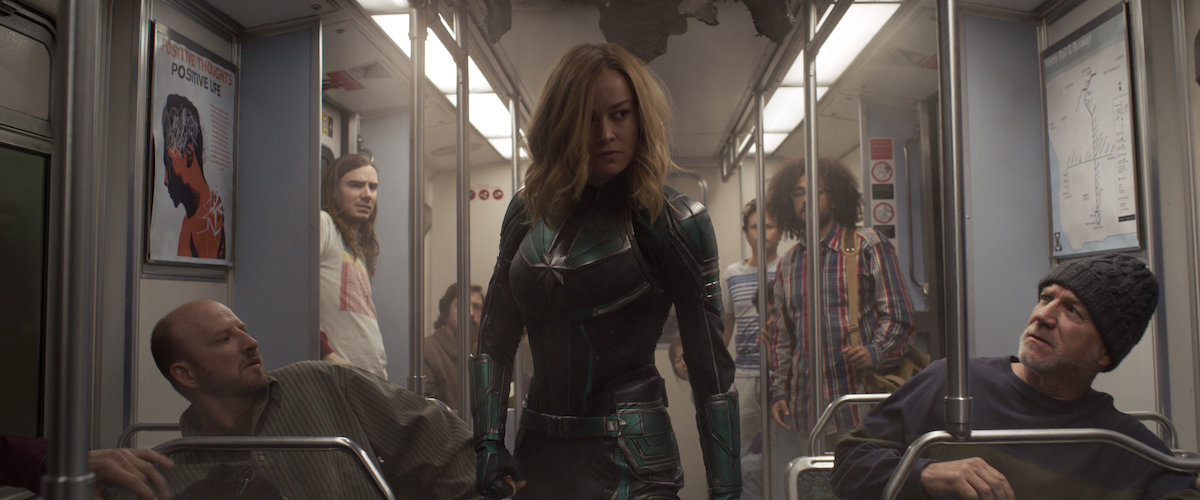
Brie Larson was so unforgettably powerful in Room (2015), for which she won a Best Actress Oscar, and yet so lacks a spark in Captain Marvel.    Maybe it is because the movie's blandness just weighs her and everyone else down.   The latest Marvel adventure isn't awful, just pedestrian.   It elicits little more than a meh. 

I can't help but think of Bill Maher's recent editorial about comic book movies, in which he points out how everyone in these movies is after a "glowy thing".   And wouldn't you know it?   In Captain Marvel, the glowing, sky blue cube called the tesseract, which we've seen in other Marvel movies, is the coveted object of the heroes and villains alike.   I recall seeing the tesseract before and I can't say with any certainty what it does, but it looks cool and supposedly contains a great deal of energy.    Captain Marvel takes place in 1995 and the folks in this movie will be happy to learn their 2019 counterparts will still be after more glowing objects.

We first meet the soon-to-be Captain Marvel as Vers (Larson), who resides on a distant planet ruled by the Kree, a race at war with a hostile civilization of shape-shifters who can mimic anything living "right down to the DNA".   Vers trains to be a Kree soldier under the auspices of Yon-Rogg (Law), and even though Law plays a seemingly good guy, his beady eyes can't help but give away his true intentions down the road.    Having Jude Law in your movie is practically a built-in spoiler alert.
Vers is haunted by dreams and visions of her past, in which she may or may not have been an Air Force fighter pilot on Earth and the Kree known as Supreme Intelligence (Bening), may be someone from her past as well.

Vers follows some shape-shifters to Earth and crash lands through the roof of a Blockbuster Video. 
Since it's 1995, you can be sure there will numerous pop culture references, including No Doubt's Just A Girl playing on the soundtrack as Captain Marvel engages in battle with some baddies.    On the scene is the ubiquitous Nick Fury (Jackson), who has both eyes working here, but we later find out at long last how he got that ominous patch over his left eye.    I won't dare spoil that, but it's rather innocuous.   

The plot is barely one we care about, and the emotional effect of Vers regaining memories of her past are muted.    The movie itself could use the powers of the tesseract to jump start the excitement level.
Captain Marvel suffers from a sagging backstory.    Captain America and Iron Man have compelling histories before they ever became superheroes, while Captain Marvel simply doesn't.    Larson is as skilled and appealing an actress as there is, but Captain Marvel almost keeps her shackled, which is the last thing you would expect in a Marvel movie.