Friday, December 2, 2016

Ghost (1990) * * * 1/2

Image result for ghost movie pics

Directed by:  Jerry Zucker

Starring:  Patrick Swayze, Demi Moore, Whoopi Goldberg, Tony Goldwyn, Rick Aviles

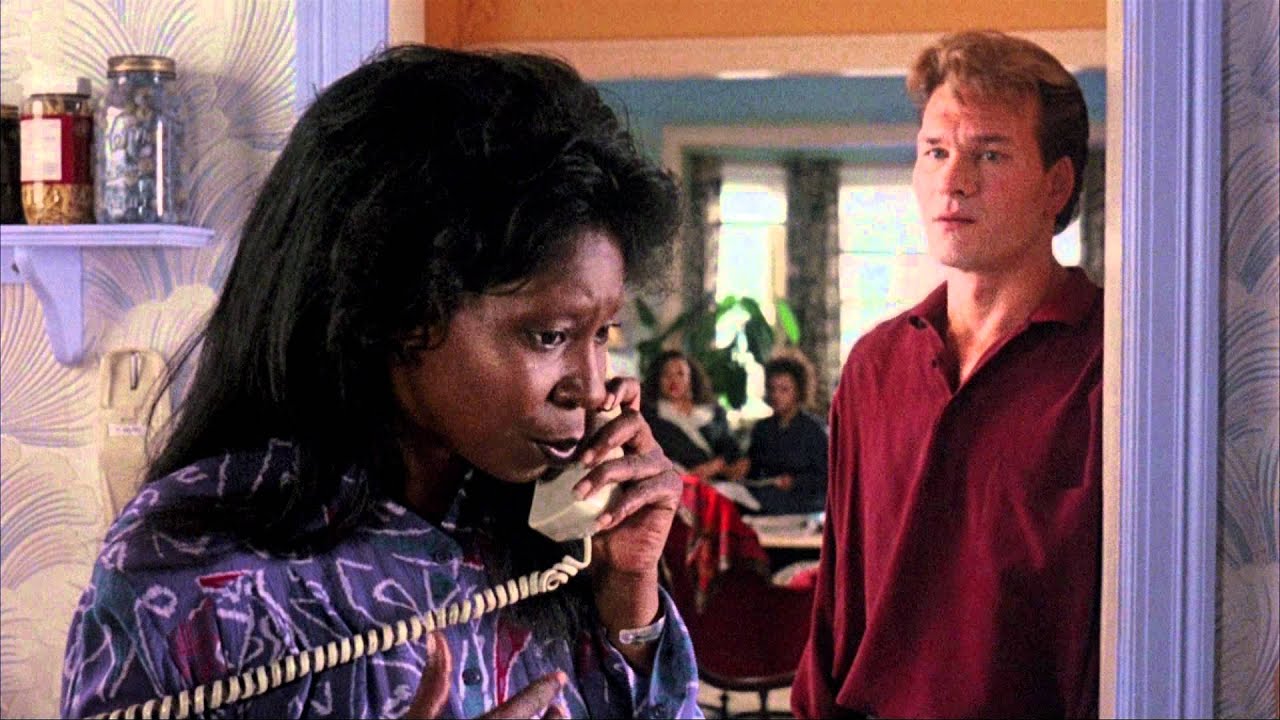
Ghost taps into the universal hope and belief that somehow death is not the end, but a new beginning.   We take comfort in the thought that our loved ones may have passed on, but are still watching over us.    This is the case with Molly Jensen (Moore), who is grieving the loss of her murdered boyfriend Sam (Swayze) after a mugging.   She is despondent and in mourning, not knowing that Sam still walks as a spirit with unfinished business here on Earth.

Sam's death was no accident, but a contract killing.  He was about to discover a massive money laundering scheme at his bank and was killed for it.  He cannot reach Molly directly to tell her that her life is in danger, but has the good fortune to stumble upon phony psychic Oda Mae Brown (Goldberg), who much to her surprise and chagrin can hear Sam.    Molly is slow to believe Oda Mae's claims that she is reciting Sam's words to her verbatim.     Oda Mae seems to know about Sam's most intimate moments with Molly, yet Molly doesn't believe her.    Meanwhile, the villain, fellow investment banker and Sam's friend Carl (Goldwyn) is hovering waiting to either kill Molly or bed her.   

What keeps Ghost grounded is the feelings of loss, despair, and frustration both Molly and Sam feel.    Molly is course missing her lover, while Sam not only misses her, but has to go through the hell of being so close to her without being able to touch her or communicate.   Being a ghost has its advantages, such as being able to move objects and going anywhere undetected, but there are downsides too.  Bruce Joel Rubin's Oscar-winning screenplay deftly handles these conflicting pros and cons.   

Swayze is a sympathetic ghost, while Goldberg appears as needed comic relief.  Swayze and Goldberg play well off each other.  Their initial antagonism gives way to friendship and mutual respect, with Goldberg adeptly coming to terms with the fact that she is not a fake after all.   Poor Demi Moore has to play most of her scenes with tears in her eyes, but she is less inaccessible here than she was in other movies.     Moore was never an actress I warmed up to.    She is attractive, yes, but something always kept me at arm's length.    In Ghost, she at least allows us a glimpse inside.

Ghost moves along to a very moving conclusion and earns its emotional impact.    How many people would love to see their deceased loved ones one last time?   Even for just a few moments.    Ghost also takes up the argument that the deceased wouldn't mind a few more moments with the ones they left behind.     All of this neatly wrapped up in a plausible thriller.    What more can you ask for? 

Fast Times at Ridgemont High (1982) * * *

Image result for fast times at ridgemont high photos

Directed by:  Amy Heckerling

Starring:  Jennifer Jason Leigh, Sean Penn, Judge Reinhold, Phoebe Cates, Robert Romanus, Eric Stoltz, Ray Walston, Brian Backer, Vincent Schiavelli, Forest Whitaker

Fast Times at Ridgemont High is a welcome relief from crude teen movies where bodily fluids are ingested accidentally.    Yes, the teens in the movie engage in lots of sex and frank sexual talk, but it is relatively tame when seen today.    It is not a bad thing.    Fast Times also follows the trend of actors in their twenties playing teens.   But there are good actors here.   Some, like Sean Penn, Nicolas Cage (in a small role), and Forest Whitaker later became Best Actor Oscar winners.   Others, like Jennifer Jason Leigh and Judge Reinhold, became well-known character actors.    And then there is Ray Walston, the former My Favorite Martian who appears as Mr. Hand, who makes it his mission to take his revenge on stoner Jeff Spicoli (Penn) for wasting so much time in his history class.

Fast Times touches on teen issues such as sex, love, passing finals, drugs, entering the workforce, masturbation, and even abortion.     These are done more or less frankly and realistically.   These issues still exist today, along with the advent of social media, cyber bullying, and deadlier sexually transmitted diseases such as HIV, which was only in its early stages of discovery in 1982.  But dealing with teen pregnancy presents enough quandaries for an otherwise nice teen girl like Stacy Hamilton (Leigh), who has a fresh face and a winning smile.    Her older brother Brad (Reinhold) works and goes to school.   His longtime girlfriend breaks up with him and he resents having to wear humiliating outfits at his job.    He changes jobs as often as he changes underwear, but he seems to be jumping out to a head start in the working world.    ("You tell me the fun is over.  I'm waiting for the fun to start.").   Oh and he is the guy caught jerking off to Linda (Cates), of whom he fantasizes emerging from a swimming pool in a teeny red bikini.   

There is no plot, per se, just a series of interlocking situations and stories surrounding these teens.    Spicoli smokes lots of dope, barely passes class, and yearns to be a famous surfer.    Is there even such a thing outside of Point Break?    When asked about getting a job, Spicoli replies, "All I need are some cool buds and some tasty waves and I'm fine,"    That and pizza he orders to eat while in Mr. Hand's class.    

Other characters rounding at the cast include Mike Damone (Romanus), a ticket scalper who hooks up with Stacy even though his best friend Mark Ratner (Backus) likes her.    He gets her pregnant, but bails on her in her hour of need, forcing Linda to take action on Stacy's behalf.     Also showing up is linebacker Charles Jefferson (Whitaker), whose prized new car is crashed by his kid brother and Spicoli and, through some ingenuity on Spicoli's part, winds up taking out his frustration on a rival football team during a game.

The movie, 34 years later, maintains a certain innocence oddly enough.    Before teen comedies became raunchy, cynical spectacles, Fast Times actually tries to relate to its characters and make them identifiable.    Advice such as, "If you want to score with a chick, play the second side of Zeppelin IV," is dispensed by Damone, who barely knows what he is talking about himself.    One minor issue:   In the next scene, Ratner is playing Kashmir on his car stereo to impress Stacy, but Kashmir is on Physical Graffiti, not Zeppelin IV.    Some teens have a knack for not knowing what they are talking about, but somehow sounding convincing anyway.  

Thursday, December 1, 2016

Allied (2016) * * * 1/2

Allied Movie Review

Directed by:  Robert Zemeckis

Starring:  Brad Pitt, Marion Cotillard, Jared Harris, Matthew Goode

Max Vatan (Pitt) arrives in World War II Morocco to meet the woman who will pose as his spouse for an assassination operation.    He is a Canadian spy while she, Marianne Beausejour (Cotillard) is French.    His French is pretty good she says, but his Parisian accent needs work.    They live together under the guise of being married, all the while setting up the assassination of the local Nazi ambassador.     We see the two actually like each other and will inevitably fall in love.    In another movie, the plot would end there.    In Allied, it is merely the setup to a second half in which the same people struggle with internal conflicts that threaten the crush them and their love.     They marry and have a child, but soon Marianne is under investigation as a Nazi double agent and Max must execute her if it turns out she is one.

I'm not really giving away spoilers, since the movie's trailers made these plot points crystal clear.    Allied works better in manufacturing its suspense by internalizing Max's conflict of loyalty to his family vs. loyalty to the Allied war effort.    Once the accusation is made, Max is forced to try and behave normally while conducting an unauthorized covert investigation.    He wants desperately to exonerate her.    He is like the patient who looks for second, third, and fourth opinions in an attempt to hear news he wants to hear; even if it isn't the truth.

Pitt and Cotillard create a believable, grounded relationship.    She more or less retires from the spy game once their child is born in war torn London, where Luftwaffe attacks commence often and take shelter alarms are sounded and heard for miles around.     In one very convincing sequence, we see a plane shot down that just misses the Vatan home.    The reality of war threatens to emotionally, if not physically, take its toll on them.    It may even tear them apart.     They are convincing as lovers and they are exceptional actors.    Everything else falls into place after that. 

Robert Zemeckis is a master at marrying seamless visuals with engrossing stories.    Allied has a feel of world events pressing down on the Vatans, especially in London, which was ground zero for the Allied war effort in Europe.   We know the outcome can either be Marianne is innocent and this was all a mistake, or that she is indeed guilty.    The odds of being the former are unlikely and watching movies, we all kind of know this even if we hope for the best.    Allied isn't as much about the plot as about love attempting to flourish in a world that has no place for it.    In the spy world, love may not be possible because the lovers are forever playing parts.    They don't know what is real and what is for show in each other.    After a while, they might not even be able to tell the difference in themselves.    And that could be deadly for one or both. 


Monday, November 28, 2016

Doctor Strange (2016) *


Doctor Strange Movie Review

Directed by:  Scott Derrickson

Starring:  Benedict Cumberbatch, Chiwetel Ejiofor, Tilda Swinton, Mads Mikkelsen, Rachel McAdams, Benjamin Bratt, Benedict Wong, Michael Stuhlbarg

Doctor Strange makes Thor seem charismatic by comparison.    Thor does show up in Doctor Strange as a probable tie-in to the next Thor sequel, but you may want to count me out for that one.    But before I discuss not seeing the next Thor movie, I will discuss the one I saw:   Doctor Strange.    It is, in a word, a mess.    It steps wrong from the opening minutes and never steps right. 

There is a plot in here somewhere and something Doctor Stephen Strange (Cumberbatch) and his allies must do to prevent the Earth from being swallowed up.     But, trying to recall it takes monumental effort I'm not willing to give.    Who cares anyway?    Doctor Strange offers nothing to root for or against.    The only thing we care less about than Doctor Strange's evolution to a defender of the psychic world (I think) is the villains plot to usurp it for their leader.   

As the movie opens, Doctor Stephen Strange is a brilliant, arrogant, aloof neurosurgeon who is involved in a horrific car crash which injures his hands and renders him useless as a surgeon.    Desperate to regain the use of his hands for surgery, Strange's journey takes him to Nepal, where he learns not only how to use his hands, but to fight the forces of evil.     Most people would go through a great deal to be able to use their hands again, but this?    The good Doctor is trained by The Ancient One (Swinton), who is bald and dressed in a yellow cloak and Baron Karl Mordo (Ejiofor), who says banal things like, "You were destined for this."

There is a villain named Kaecilius (Mikkelsen), played by the same actor who played Le Chiffre in Casino Royale.    I would have liked him better here if he bled from one eye and played Texas Hold 'Em.     Kaecilius is a villain, I suppose, but I don't know what his function is.    He shows up from time to time only to have his flunkies killed by Strange and to meet his eventual demise.    Could it be that I nodded off twice have something to do with my hazy recollection of the plot points?

Cumberbatch provides the right amount of snark and arrogance as the title character, but there isn't much else but snark and arrogance.    Why should we be invested in Strange's plight?    There are very good actors abound in this movie left to hang around waiting for something to do.     Much has been made of casting British actress Swinton as a character which was Asian in the comic book, but there is so little to The Ancient One that it wouldn't much matter who was cast.   She tries to be interesting, like everyone else does, to no avail.   

Marvel Universe movies are known for big budget sets, CGI, and mayhem.    It is near impossible to follow what goes on in Doctor Strange.    Characters can jump from the natural world to the supernatural one with little rhyme or reason.     If there are no rules governing anything, the movie becomes a jumbled free-for-all.    The visuals are a bit on the cheesy side.    Maybe that is the intent, but it is distracting and there isn't much to distract from.

Doctor Strange is one Marvel comic book character that would have better left on the page and not the big screen. 


Tuesday, November 22, 2016

Glengarry Glen Ross (1992) * * * 1/2

Image result for glengarry glen ross movie pics

Directed by:  James Foley

Starring:  Al Pacino, Jack Lemmon, Alec Baldwin, Kevin Spacey, Ed Harris, Alan Arkin, Jonathan Pryce

Strong arming people to purchase dubious property must be a soul-crushing way to earn a living.    The salesmen in Glengarry Glen Ross have to deal with it every day.     Now there is a hotshot from downtown giving them all a warning under the guise of a sales contest:   "First prize is a new Cadillac El Dorado.    Second prize is a set of steak knives.    Third prize is you're fired,"    As if these guys didn't have enough pressure on them.

The man feeling the heat the most is Shelly Levene (Lemmon), who hasn't made a sale in ages.    He used to be the office sales king, but now he is reduced to making house calls on rainy nights to potential clients who don't want to buy what he's selling.    The current sales champ is slickster Ricky Roma (Pacino), who is across the street in a bar schmoozing a guy who is very, very unsure about buying land and even more unsure about Roma.     Roma is a smooth talker: calm, frank, and confident.     He may one day be Shelly, but as of now he is king.

One of the other two salesmen in the office of Rio Rancho Properties are Dave Moss (Harris), who forever feels he is treated unfairly.     If he concentrated on sales as much as he did griping, he wouldn't have to worry about his job.     Moss pitches his plan to his fellow hard luck case George Aaronow (Arkin) to rob the office of the "Glengarry" leads, which contain the names of people who may want to buy property.    These leads are held over the heads of the men by Blake (Baldwin), a cocky representative of "Mitch and Murray", who are the bosses much discussed, but never seen.   "I could give you the Glengarry leads, but that would be like throwing them away," he tells the guys.   He also challenges their collective manhood and provides advice (or a demand), "Always Be Closing."   

Rounding out the cast of stellar actors is Kevin Spacey as John Williamson, the office manager whom the men don't trust or respect.    He is seen as too much of a pawn of Mitch and Murray and follows the rules too closely, almost coldly, but he gets the last laugh when Shelly divulges information he shouldn't to John while insulting him during a fleeting moment in which he feels relevant again.    John is amazingly able to keep a cool, detached demeanor when dealing with these egotistical hotheads, which is either a gift or a curse.   

Other than an office robbery which remains off-screen, Glengarry Glen Ross is mostly a dialogue-driven film about desperate men; some more desperate than others.    The actors fit the roles so comfortably you would think they once were walking the sales beat.     The rain pours down at night like reality crashing down around everyone's head, unless you are on top like Roma, who seems to enjoy the tap dance he has with his new client (Pryce).     Despite the rejections and threats to their job security, you get the feeling, other than Moss, that these men enjoy the art of selling.    It is indeed an art.   Glengarry Glen Ross understands that.  


Monday, November 21, 2016

I Never Sang for My Father (1970) * * * 1/2

Image result for i never sang for my father movie movie pics

Directed by:  Gilbert Cates

Starring:  Melvyn Douglas, Gene Hackman, Estelle Parsons, Dorothy Stickney, Elizabeth Hubbard, Conrad Bain

Family relationships are anything but tidy.    Most movies want to tie up all of the loose ends with family conflicts in under two hours.    I Never Sang for My Father has no clear cut right or wrong party.    Gene Garrison (Hackman) is a recently widowed New York professor who wants to move to California and remarry.     This would mean leaving behind his elderly parents and in particular his domineering father Tom (Douglas), who frets to Gene in one of many guilt trips how such a move would crush his mother.    In reality, Tom would be the more heartbroken one. 

Before we can easily pigeonhole Tom as an irascible guilt tripper and Gene as a henpecked son who falls so easily for his father's manipulation, I Never Sang for My Father gives the two men depth, internal conflict, and of course love.    A lesser movie would have Gene finally wiggle free from Tom's grasp and live a happy life on his own.    A lesser movie would only see its people in such specific terms without allowing them to be conflicted, wounded, prideful, stubborn, and unable to communicate the words that mean the most. 

Because I Never Sang for My Father is so perceptive and knows that father-child relationships are sometimes so fragile, the movie doesn't necessarily take sides.    Sometimes we sympathize with Gene, even when he says he hates his father, which we know he doesn't mean.     Other times, we see the hurt Tom feels from having a mostly parentless childhood.     At one point, after Tom's wife dies and he is seemingly unaffected, we see him finally grieve not just his recent loss, but the loss of all of his loved ones who left him.    It is a moving moment which allows Gene to see inside, even if just for a second.

Gene is forever conflicted between his own needs and his perceived duty to his father.    At his sister's (Parsons) urging, Gene looks for nursing homes for his father and is turned off by their coldness.    Yet, the old man can't reasonably be expected to take care of his large home.    A housekeeper is out of the question too.    "I've taken care of myself since I was eight years old,"  he bellows defiantly.    We can understand Tom's stubbornness in holding on to his independence.    As some grow older, they lose the abilities that make them independent.     Some soon can't drive anymore, then some can't live alone anymore.    Each bit of life is taken away.    How does that even feel?    Could we blame Tom for being hesitant to leave his home behind?     

I realized with surprise that I Never Sang for My Father is not about one giant conflict between father and son, but little ones that have blossomed into big ones.     Tom and Gene's cold war is based more on perceptions than reality.    Gene feels his father never truly loved him.    Tom feels unappreciated by Gene.     What both men may never see is how much they truly do love each other, if they can get out of their own way to understand it.

Melvyn Douglas and Gene Hackman are both two-time Oscar winners with long, distinguished careers.     Both are so good at suggesting the subtle pain underneath.    We think we know who they are, until they peel back another layer for us to see more and sometimes unexpectedly.    This is their movie, although Estelle Parsons (Bonnie and Clyde) also excels as an almost outsider voice of reason.    She was banished by Tom from their home for marrying a Jew, but she sees this almost as a blessing which forced her to become truly independent, which is yet to happen for Gene.

I found the lack of a tidy resolution to I Never Sang for My Father to be appropriate.    There are so many dimensions to these people to work through that we will never get to the bottom of their relationship.    Sadly, most relationships are complex like that and a resolution may never fully come.    "Death ends a life, but it doesn't end a relationship," says Gene, who is still wrestling with his conscience and his soul long after his father is gone.    Sometimes the worst things that can happen to a relationship are the things you didn't do or say. 


Hacksaw Ridge (2016) * * * 1/2

Hacksaw Ridge Movie Review

Directed by:  Mel Gibson

Starring:  Andrew Garfield, Vince Vaughn, Hugo Weaving, Teresa Palmer, Luke Bracey, Sam Worthington, Rachel Griffiths

With Hacksaw Ridge, Mel Gibson once again proves his directorial prowess.     He made a promising debut with the touching The Man Without a Face (1993) and then won the Academy Award for Best Director for Braveheart (1995).    The Passion of the Christ (2004) was a huge hit, although I am not among its admirers.    His follow-up, Apocalypto (2006), was a bloody, ugly mess.     Now, Hacksaw Ridge, Gibson's first directorial effort in a decade, tells a stirring story about pacifist medic Desmond Doss (Garfield), who was awarded the Congressional Medal of Honor for his heroic efforts in saving the lives of 75 men during the raid on Okinawa in May 1945.    And he refused to even carry a weapon.

Hacksaw Ridge isn't preachy nor does it bestow saintly status on Doss.    He is a likable young man who will not bow in his pacifist beliefs despite enormous pressure by the Army to do so.    His refusal to even touch a rifle makes him the subject of ridicule, scorn, and violence by his fellow platoon members.     Drill sergeant Howell (Vaughn) can scarcely believe what he is seeing.    Howell's commanding officer Captain Jack Glover (Worthington) has Doss sent for a psych evaluation.    Why would someone volunteer to join the Army if he refuses to kill, or even carry a weapon? 

Doss wishes to serve as a medic, in the hopes of saving lives while everyone else is taking them.    He is court-martialed but wins his case with help from his alcoholic World War I veteran father (Weaving), who calls in a favor to his former superior.    Doss is labeled a coward, but we see he is anything but one.    His refusal to acquiesce wins the support of his platoon, especially Smitty (Bracey), who was at first his harshest critic but soon becomes his best friend.     Doss also has the support of a loving bride (Palmer), who only wants him to return safely home to her.

Doss' beliefs spurn partly from religious doctrine but also from an ugly childhood memory involving his father abusing his mother.    He was so shaken by the experience that he vows never to touch a gun again.   He doesn't, but when the Americans suffer heavy casualties and wounded men in the brutal battle to take Hacksaw Ridge, Doss evades enemy fire and discovery to save the lives of 75 wounded men.     No one would dare question his courage after that.

The battle scenes are particularly bloody and brutal.    Anyone who has seen previous Gibson-directed films should not be surprised by this.     Gibson seems to like his action films on the violent side.    Decapitated heads, disemboweled intestines, and spurting blood are not uncommon with Gibson.     But it sets the stage for Doss' heroism and we are all the more stirred by it.     Hacksaw Ridge manages to avoid most of the traps a war biopic sets, unlike Unbroken (2014) about a World War II hero who was celebrated for experiencing what thousands of other fighting men experienced.     I don't think too many men can say they dragged 75 men to safety following one of the most vicious battles on the Pacific front.

Garfield is the right choice for Doss.    Slight of build, he has a way with an infectious grin and his persistence during his sweet courtship of Dorothy.    But underneath the cheerful exterior lies a person undaunted by scorn and fear.     He doesn't behave like he should have a statue built in his honor or have a movie made about him.    He simply stands up for what he believes in and sticks to his principles no matter how inconvenient sticking to them becomes.

Many of the supporting players are effective even though many serve only the function of being dead wrong about Doss and apologizing for it in their own way.    It was surprising to learn many of the actors, except for Vaughn who is American and Garfield who is British, are Australian, but they have spot-on American accents.     It is also surprising to learn that Doss' deeds weren't trumped up or made to be mythical, but more or less happened the way Gibson shows them.     Doss died in 2006 at age 87 and I will bet not one of the men he saved would dare begrudge him for not carrying a rifle.