Friday, December 8, 2017

The Matrix (1999) * *

Image result for the matrix movie pics

Directed by:  Andy Wachowksi and Larry Wachowski (now Lana and Lilly Wachowski)

Starring:  Keanu Reeves, Laurence Fishburne, Carrie Anne Moss, Joe Pantoliano, Hugo Weaving

The Matrix is technically sound, but entirely overburdens us with plot complications, swerves, and gun and/or fistfights.    Consider this:   Machines and computers take over the planet (a la The Terminator) and create "The Matrix", in which seemingly ordinary daily life is really a disguise for their evil intentions.   Humans aren't humans at all, but just batteries in waiting for the machines to use to keep themselves charged and keep "The Matrix" going.    As described by the portentous Morpheus (Fishburne), who leads the rebellion against the machines, the average human body emits enough electricity to run entire computer networks.    So, the planet is now a farm to grow humans and thus more batteries.  

Fair enough.    But because the machines have the technological savvy to create such a dynamic, how can their allow their fate to be decided on the outcome of a fistfight or an ordinary handgun?    They can rule the world, but can't create better security than sinister agents in suits and sunglasses getting into shootouts?    Or going mano y mano with the good guys?    And since the movie possibly takes place two hundred years in the future, hasn't communication advanced past dial-up modems, rotary telephones, and pay phones by then?    At least the Back to the Future guys were able to have some fun with their vision of the future.

If you compare the world of "The Matrix" with the world of the rebels, the rebels got shafted.    The world of the rebels is confined to a dingy, dank spaceship which looks like something which would wind up on the Star Wars scrap heap.    They eat disgusting gruel, yet seem to have flashy black threads, overcoats, and shades handily nearby so they can look mighty conspicuous while trying to defeat the machines.     Characters are given a choice to take a red or green pill, one which will allow them to slip back into "The Matrix" and the other to continue to learn about "reality".    One character decides to take the pill which would allow him to go back to "The Matrix".    Who could blame him?  The characters are thrust back and forth between alternate realities, dimensions, and planes so often we lose our footing, which may be intentional. 

Morpheus recruits computer programmer Neo (Reeves) to lead the revolution against the machines.   Neo is shown humans' true fate and learns how hand-to-hand combat in much the same way Obi-Wan taught Luke Skywalker how to use a light saber.    We soon realize the high concept storyline will give way to typical action movie clichés and a final battle between Neo and Agent Smith (Weaving), the menacing leader of the agents assigned to protect "The Matrix".    Helping Neo and Morpheus are a ragtag group of rebels which include Trinity (Moss), who seems to have a generous supply of leather pants and tops at her disposal so she can look sexy while battling the bad guys.  

Neo is consistently referred to as "The One" by Morpheus and Trinity, and Neo is indeed an anagram of "one" (whoa), so the movie pounds it into our heads that he was born to be the leader of the revolution.    As the movie creaks to its conclusion, Morpheus must repeat "He is The One" five times if he says it once.    The Matrix has nifty choreography and some interesting visuals, while Reeves is a sturdy action hero, but the story is borrowed from elements of The Terminator, while the action scenes harken back to westerns and martial arts films.     The problem is it never achieves liftoff or much of a reason to care if the rebels succeed.     The way I see it, besides the whole "eventually you will be used as a battery" thing, the folks in "The Matrix" have jobs, lives, and are blissfully unaware of what will happen.    All things considered, they could be on a rundown spaceship eating crap and using cheap, outmoded teleporting equipment, but they know their fate.   As one of the characters puts it, "Ignorance is bliss". 


Wednesday, December 6, 2017

What About Bob? (1991) * *

Image result for what about bob movie pics

Directed by:  Frank Oz

Starring:  Bill Murray, Richard Dreyfuss, Kathryn Erbe, Julie Hagerty, Charlie Korsmo

Watching What About Bob? again for the first time in a long while, I enjoyed it more than I did when it was released in 1991.    Bill Murray didn't grate on my nerves this time, but the movie remains a one-joke enterprise in which the guileless, clueless neurotic Bob Wiley (Murray) slowly drives his shrink, the uptight Leo Marvin (Dreyfuss), insane.   

As What About Bob? opens, Bob, whose neuroses are so bad he can't touch anything without holding a Kleenex and is terrified to leave his house, is referred to Leo after driving his former shrink to quit his practice.    Leo tells Bob to contact him after he returns from his month-long vacation, which will not do for Bob, who feels he will lose it if he is not able to see Leo.    Through some underhanded means, Bob finds out where Leo is spending the month with his family and travels there to see him.    This does not sit well with Leo, who not unreasonably feels Bob is intruding on him.    The rub is:  Leo's family takes to Bob and likes him, which makes Leo all the more enraged.  

Leo attempts to get rid of Bob, first subtly, then dropping him off at the nearest mental institution, which doesn't work.    Bob keeps finding a way back into Leo's life, without being able to take the hint that Leo can't stand him.     Good Morning America plays a role in the film, as Leo's new book is featured, but we see he clearly doesn't follow his own advice when it comes to Bob.    We see changes in Bob, who learns to be less neurotic and in control of himself, while Leo devolves into frustrated lunacy.  

So why doesn't What About Bob? not quite work?    There are inspired moments in which Dreyfuss masterfully gives us the slow burn.     He is a funny straight man, a man who just wants to be left alone, while Bob ingratiates himself into Leo's life whether he likes it or not.     The movie is sporadically funny, but not overly satisfying as a whole.    Maybe it is because Leo's trajectory doesn't shift at all.    He doesn't learn to accept Bob or to become a better shrink.    He is just driven mad in an escalating fashion, and this can only go so far before it grows tiresome.    There are times when the film borders on slapstick, such as when Bob performs a Heimlich maneuver on Leo so painful Leo probably would've been happier choking to death.   

Director Frank Oz has made some great comedies, including the masterful Dirty Rotten Scoundrels (1988), Bowfinger (1999), and charmers like Housesitter (1992), In & Out (1997), The Stepford Wives (2004), and even a strong caper film, The Score (2001).    He is adept at making subtle comedies with more emphasis on satire and characters than over-the-top situations.    What About Bob? is a bit out of his element.    I think of the Oscar-winning short film The Appointments of Dennis Jennings (1988) in which comedian Steven Wright plays a neurotic regular patient of a competent shrink (Joe Mantegna) whom he slowly drives mad.    The movie mostly takes place in the shrink's office, but we see how their dynamic slowly and subtly unnerves the normally in-control Mantegna.    I would have liked to have seen the same idea applied here, with Murray and Dreyfuss doing their stuff while leaving everyone else home. 

Richie Rich (1994) * * *

Image result for richie rich movie pics

Directed by:  Donald Petrie

Starring:  Macaulay Culkin, John Larroquette, Edward Hermann, Christine Ebersole, Jonathan Hyde, Michael McShane, Chelcie Ross

I vaguely recall the Richie Rich cartoon series I saw growing up.    It was not one which screamed for a live-action remake, but Hollywood chose to make it anyway.    Richie Rich was released in 1994, when star Macaulay Culkin was four years removed from Home Alone and following a string of flops.    Does anyone recall The Good Son, where Culkin plays a ten year old psychopathic killer?   Yes, such a movie was made.    Richie Rich isn't simply a Culkin vehicle, but has enjoyable performances by the film's adult co-stars and a certain sweetness and charm.   

The title character is the world's richest twelve year old, who because of his wealth, has no friends his own age and is followed around by the loyal butler Cadbury (Hyde).    His parents are not cold and aloof, but warm and loving, which goes against expectations.    Soon, Richie wins over some classmates, but then things go awry when a scheming executive at his father's company hatches a plot to take over the company and gain control of the Rich family wealth.    The executive, aptly named Laurence Van Dough (Larroquette) is properly smug and oily, two traits Larroquette has mastered in movies like Stripes and his multiple Emmy-winning role on Night Court.

Richie Rich isn't simply a "kid's movie", but contains sly satire and people we care about because, other than Van Dough and his henchmen, they are nice.    In one amusing scene, the ever optimistic Mr. and Mrs. Rich are stranded at sea in a lifeboat, but everything will be ok because the emergency kit contains plenty of caviar and champagne.     Van Dough is after the Rich family vault, which is discovered to be its own Mount Rushmore-like mountain called Mount Richmore.    Van Dough tells Mr. Rich, "You are just filthy rich, aren't you?"    What the mountain actually contains produces a big laugh and a touching aspect of what the Rich family is all about.

Culkin is appropriately likable as Richie, so we care about him.   This would be Culkin's last movie for nine years.    He returned to the screen in 2003's Party Monster, which coldly told the story of a murderous professional party animal hired to show up at openings of New York's trendiest night clubs.    I enjoyed the movie and admired Culkin's range.    I even thought Culkin could successfully transition to a twentysomething movie star, but that was not to be.    He faded into obscurity again after a couple more little seen films and a guest spot on Will & Grace.    Hollywood churns people up and spits them out, to be sure, even charming young actors like Culkin whose star shone so bright at one point we thought it would last forever.    Or at least longer than four years. 

Tuesday, December 5, 2017

Bugsy (1991) * * * 1/2

Image result for bugsy movie pics

Directed by:  Barry Levinson

Starring:  Warren Beatty, Annette Bening, Ben Kingsley, Harvey Keitel, Elliott Gould, Joe Mantegna

Mobster Benjamin "Bugsy" Siegel (he hated the nickname) created a paradise in the Nevada desert out of a vision of bright lights, show biz, and of course untold fortunes to be made by gamblers losing their shirts.    He did not live to see it because he was gunned down in his home.  Siegel ran afoul of his own mob brethren by blindly falling in love with wannabe starlet Virginia Hill (Bening), who stole $2 million from the mob during the Flamingo's construction.   Things ended up a lot better for Las Vegas than it did for Siegel.  The notorious gangster's fall is compellingly on display in Bugsy, which combines glamour, wit, rage, violence, and the business of the mob in a smartly-acted and deftly- directed film.

Warren Beatty might not be the actor you see playing a violent mobster, but you sure can see him playing the smoothie side of Bugsy Siegel.    Beatty is able to negotiate the extremes of Bugsy, making him a charmer one minute and a raging psychopath the next.    What kinds of things trigger his temper?   Calling him Bugsy, for sure, but also stealing from him, lying to him, and being an unfortunate soul who is seen with Virginia, even if the guy turns out to be her brother.   No worries.  Bugsy is the kind of guy who apologizes and buys the guy he just pounded a new car.   This is one of the best performances of Beatty's long career. 

Bugsy opens in early 1940's Hollywood, with the New York mob run by Siegel, Lucky Luciano, and Meyer Lansky (Kingsley) looking to gain a foothold in Los Angeles.    Siegel is immediately seduced by Hollywood's glamour and rubs elbows with movie stars, including smart Virginia, who doesn't instantly fall into Siegel's arms but makes him work a little bit to win her.    Their relationship is passionate and tempestuous, not helped by Siegel's womanizing ways and his hair-trigger temper.    One telling scene involves Virginia witnessing Siegel's dressing down of a thieving associate and then, turned on by Siegel's raw power, seduces him while blood trickles down his face thanks to an ashtray she threw at him moments before.

Bening and Beatty, of course, married following the filming of Bugsy and are still together today.    Virginia is no pushover.   We meet various Siegel associates, including Harvey Keitel as murderous mobster Mickey Cohen, who at first stole from Bugsy but then entered into a partnership with him.    Ben Kingsley, as Meyer Lansky, has tricky scenes in which he must weigh his loyalty to his lifelong friend versus what is best for business.   When Bugsy conceives of the Flamingo Hotel, he stops at nothing to achieve the dream of seeing it, including costly overruns and fraudulent share sales which guarantee capital while potentially swindling investors out of a return.  Once Bugsy has a vision, he does not let go of it.  "You will have nothing," says Lansky, "After all of this, nothing".

Levinson moves things along briskly, finding time to introduce Bugsy's long-suffering wife and children who have come to terms with who the type of husband and father he is.   He dotes on his kids, which is the side of Bugsy we can't imagine existing when he murders a longtime friend who turned state's evidence against Lucky Luciano.   Bugsy is not a film which glorifies the mob or its traditional values.  It sees the business of crime as a cold and calculating numbers game.  The people aren't as colorful as a Henry Hill or a Jimmy Conway in Goodfellas.  Bugsy doesn't exude that type of energy, but instead gives us an unflinching view of crime as a moneymaking enterprise.  It is a business, much like corporations, including the ones which run Las Vegas.    The legal corporations are no less cold and bottom line driven as the mob.   Only the mob carries guns. 


Monday, December 4, 2017

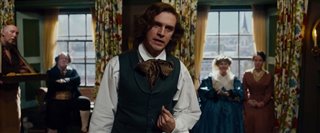
The Man Who Invented Christmas (2017) * *

Image result for the man who invented christmas movie pics

Directed by:  Bharat Nalluri

Starring:  Dan Stevens. Christopher Plummer, Jonathan Pryce, Morfydd Clark, Miriam Margolyes, Anna Murphy

The Man Who Invented Christmas speculates how Charles Dickens was inspired to write A Christmas Carol, his most enduring and endeared work in a literary career which included Great Expectations, Oliver Twist, David Copperfield, and A Tale of Two Cities.     Dickens was a rock star among authors in his day.    Most writers would be fortunate to write one timeless classic, Dickens wrote at least five.    But, it is A Christmas Carol, seen in this movie as a desperate cash grab, which remains perhaps his most famous work.  

The film's plot evokes Shakespeare in Love, with a thirtyish Dickens (Stevens) having severe writer's block and desperately needing a hit after three flops in a row and a mountain of debt piling up due to home repairs and an ever-growing family.    He can't write a thing, even as he promises to publish a new Christmas novel six weeks out from the holiday.    But, the young Dickens receives his inspiration from some unlikely sources.    One is his new maid Tara (Murphy), who shows Dickens a ghost story she enjoys, and a chance encounter with a mean, old miser (Plummer), who becomes his Ebenezer Scrooge.   

The characters sprout to life in his head, but follow him around as a reminder of the pending deadline and how A doesn't exactly lead to B or C in the novel's plot.    How does he write a satisfying ending in time?    His imaginary Scrooge is no help, as he taunts the vexed Dickens with reminders of his failure.    Dickens' own life has some parallels to the story, including a stint in a London workhouse as a child due to his father's (Pryce) irresponsibility and failure to pay debts.     His father pops in, forever looking to borrow money from his strapped son, which exasperates Charles to no end.    Can Charles work out his own demons as a way to achieve the ending he desires?   

All of this sounds more intriguing than it actually is.    Charles is provided Eureka! moments as he encounters an elderly waiter named Marley, a heartless politician who gives Charles the whole "are they no workhouses?" speech at a speaking engagement, a boy with a crutch who serves as Tiny Tim, etc. etc.    While these scenes are fleetingly cute, they don't provide much dramatic pull, which can be said for the entire movie.    There are brief scenes in which we think we are on to something, only to realize these moments are islands onto themselves.     There is no big emotional tug to keep us interested from beginning to end.

Dickens, as played by Stevens, is a rather combustible, egotistical fellow whom one could argue is the younger version of Scrooge himself.     He mugs often, coming off as a cartoonish version of the great author.    Plummer, with his quietly cruel take on Scrooge (or the inspiration behind him), recites some of the famous Scrooge quotes with the authority such as great veteran like he can provide.     He doesn't ham it up, which makes it all the more menacing.    Another great film and stage veteran, Jonathan Pryce, is a joyous guy who is completely irresponsible with money, but we know he has a big heart.    We wish Charles would give him a break already.    Dickens' wife (Clark) isn't given much to do except look disappointed, puzzled, or be in the dark about her husband's business.   

The Man Who Invented Christmas has the feel of a Hallmark holiday movie, with a cutesy score and broad plot points we can see coming a mile away.    Its vision of 1843 London is convincing enough and in the end, the epilogue tells us how A Christmas Carol became an instant hit and changed the way Christmas was celebrated as a holiday of charity, love, and warmth.    Tell that to the people who will run you over on Black Friday while trying to get their hands on the latest gadgets on sale between 6-10am.  


Wonder (2017) * * *

Wonder Movie Review

Directed by:  Stephen Chbosky

Starring:  Julia Roberts, Owen Wilson, Jacob Tremblay, Izabela Vidovic, Noah Jupe, Daveed Diggs, Mandy Patinkin, Nadji Jeter

Wonder does not make the mistake of laying on the cuteness and schmaltz too thick.   A story of a 10-year-old boy disfigured since birth making his way through his first year of school could easily go in that direction, but Wonder wisely chooses to tell its story from other points of view.    We become involved in the stories of up to three other characters besides Augie (Tremblay, who was magnificent in 2015's Room and very good here), which I didn't expect and was pleasantly surprised to see.

We see Augie at birth, born to kind, sweet, and patient parents Isabel (Roberts) and Nate (Wilson) Pullman, and with various complications which needed 27 surgeries to either correct or at least improve Augie's quality of life somewhat.    Augie's face is deformed, which causes him to wear an astronaut's helmet in hopes of hiding it.     He will soon go to school for the first time after years of homeschooling, which naturally causes concern for his family, including his older sister Via (Vidovic), who has taken a backseat to Augie.    Via loves Augie and despite her jealousy maturely understands why Augie needs so much attention.    Yet, she says it would be nice for her mother to throw a little face time to her once in a while. 

Augie is smart, self-deprecating, and is at first an outcast at school.    Some bullies overtly show their displeasure with him, while others just stare at him enough to make Augie uncomfortable.    Despite this, Augie makes friends with popular boy Jack Will (Jupe) and soon other classmates, although these friendships are tested throughout the school year.    We witness Augie grow and slowly learn not to be the center of his family's universe, although after years of being used to such attention he simply assumes everyone will drop what they are doing to tend to his fits of anger. 

One way Wonder works unexpectedly is not allowing Augie to be a one-dimensional epitome of Cute.    He is allowed to make mistakes, to be a brat, and then learn there are other people in the world with needs besides him.    Tremblay, a gifted actor, navigates these challenges expertly.    While Roberts and Wilson receive top billing, the movie belongs to the kids.     We see Via join the drama club and fall in love, while dealing with the sudden rejection of her longtime friend Miranda who comes home from summer camp and ignores her.    Why does Miranda do this?    We discover the reason from Miranda herself, who is at once part of the Pullman extended family dynamic while also being envious of it.

The adults in the film are played warmly, including Mandy Patinkin as the school principal Mr. Tushman (he shows in a funny scene he has come to terms with his unfortunate surname) and Daveed Diggs as Pullman's teacher who once worked on Wall Street, but now has channeled his passions into teaching.     Although the parents of Augie's main antagonist are painted broadly as snobby, insensitive creeps, there is still a touching moment where their son rises above them.     Roberts and Wilson exhibit a truly warm and loving relationship with a bad cop-good cop thing going. 

Wonder's story arc goes where you think it will, although thank goodness it doesn't end with an unnecessary tragedy thrown in to jerk tears where none are needed.    The movie exists in its powerful moments of revelation, in which the characters learn about themselves and we see them change and grow.     And yes the ending is clichéd (it takes place at a school assembly, where lots of movies wrap things up positively with the stirring music permeating the scene), but even though the movie overstays its welcome by a few minutes and ends with an emotional whimper when it should soar,  Wonder overall is a perceptive film with many moments of genuine power. 


Friday, December 1, 2017

Woodstock (1970) * * *

Image result for woodstock movie pics

Directed by:  Michael Wadleigh

With musical performances by:  Jefferson Airplane, Crosby, Stills, and Nash, Janis Joplin, Jimi Hendrix, John Sebastian, Country Joe and the Fish, Sly and the Family Stone, The Who, Sha Na Na, Ten Years After, Santana, Joe Cocker

The best scenes in Woodstock depict the ordinary people who descended upon Bethel, New York between August 15-18, 1969.    Any logistics planned to control the event had to be tossed out the window, since 400,000 showed up instead of the expected 50,000.     The area was declared a disaster area mostly due to the sudden influx of humanity and the lack of resources necessary to feed, shelter, and provide proper medical care for the festival goers.    A nearby Army base flew helicopters in to deliver food and airlift people safely from the event.    The movie shows us in detail how the people were fed and cared for.    An unseen speaker over a PA makes announcements.   The poor man who services the portable toilets does so with a smile on his face as he is sucking up human waste into the truck.    They were there for the music, the love, the drugs, and a respite from the Vietnam War.    I almost wish the musical performances didn't interrupt the behind-the-scenes footage, but leaving the music out would be like leaving the Nazis out of a documentary about World War II.

Most of the musical performances drone on endlessly.    The acts drift into long, boring guitar and drum solos, but soon enough we are past a musical act and concentrating more on the people.   Why would they endure such hardships to attend Woodstock?    Did they know it would be a cultural phenomenon whose impact will last as long as there is music?    Or did they want to be part of a massive group of likeminded people who stressed peace, love, and harmony during a period in which those were hard to find?    The documentary, directed by Michael Wadleigh, and edited by Martin Scorsese and Scorsese's future Oscar-winning editor Thelma Schoonmaker, amassed roughly 120 miles of footage and condensed it into a four-hour movie (I saw the director's cut) which put us right in the middle of a happening unlike any before or since.    There was Woodstock '94, a 25th anniversary celebration of the original event, but 1994 wasn't 1969 and the social issues of 1969 were not there in 1994 to permeate the event and create a need for the gathering.

Woodstock could only have taken place in the late 60s.   All of the cultural and societal conflicts and influences converged into an August weekend in upstate New York on an obscure dairy farm with rolling hills and green grass for miles.    The film wisely seeks out the opinions of the town residents, who are split on their feelings about the massive festival which essentially shut down their homes for several days.    There were no arrests, no violence, although drug use, sex, and nudity were rampant and to the surprise of many, the "kids" acquitted themselves well.    That may not have been a comfort to some people whose phones were shut off and were basically prisoners of the town because traffic congestion led everything to a standstill.

The documentary did not judge anyone.   It conveyed the awesome size and scope of the event.    We feel as if we are in the middle of it and living it.    This would be a four-star movie if, oddly enough, it had less musical performances.    I know this view may be considered sacrilegious, but my opinion is my opinion.    Even the better performances by Joe Cocker (who sings With a Little Help from My Friends) and Jimi Hendrix soon overstay their welcome.    Hendrix played on the morning of the 18th, when many people already left and roughly 30,000 remained.    Some of those 30,000 started to exit once they caught a glimpse of Hendrix.    Those who did not stay to watch him could not have foreseen that in a mere thirteen months, Hendrix would be dead of a drug overdose.    The same with Janis Joplin, who appeared Sunday night and died in 1970 also.     They may have assumed, like most people, that their heroes were too young to die so young.  

Then, as Hendrix wails away on his guitar, we see the aftermath.    Trash as far as the eye could see.   Poor folks were thanklessly tasked with cleaning it up, while those who sank their money into the event had to wait until the movie came out in 1970 to bail them out of financial ruin.    The event was supposed to be for profit, but the sheer number of people attending made it impossible to sell tickets.   So, by default, it became a "free concert", which likely drew more spectators.    For one weekend in August 1969, the Woodstock festival population became the third largest city in New York state.    Then, they dissipated, facing their lives again with possibly a degree of hope and perhaps a larger degree of uncertainty.    With the 70s and beyond looming, we gain a true sense of just how big Woodstock was.