Monday, July 23, 2018
The Equalizer (2014) * * *
Directed by: Antoine Fuqua
Starring: Denzel Washington, Marton Csokas, Chloe Grace Moretz, Bill Pullman, Melissa Leo, David Harbour
Robert McCall (Washington) is a former CIA agent who wants to live a quiet life in Boston working at Home Depot, but his sense of fair play and justice is violated when a young call girl named Teri (Moretz) comes into the coffee shop McCall frequents looking beat up. Teri is under the thumb of the local Russian mob, and McCall wants Teri to have a future, so he pays a visit to the mobsters offering them a choice: Let Teri go or face deadly consequences. The mobsters laugh at the near sixtyish McCall, but within thirty seconds, McCall thrashes the joint and the war is underway.
The Russians sent in their fixer Nikolai (Csokas), who foolishly does not fear McCall, but he will quickly learn to. McCall is not only deadly, but smart, efficient, and collected. He doesn't shout, he doesn't play around, and he isn't afraid to get dirty. The mobsters think they their fates will be different, but we know better. But, yet they trudge along trying to outwit and outmuscle McCall to their detriment.
Even at 59 at the time this movie was released, Washington was still a convincing Robert McCall. He isn't Superman and the stunts and fights aren't over the top except in sheer brutality. McCall gains justice in bloody, nasty fashion and because we care about McCall, we care about seeing the villains get theirs. In another actor's hands, The Equalizer might not have been as effective or absorbing, but Denzel Washington is a lean, efficient, quiet everyman. We learn a little of his background, with help of old CIA friends Susan and Brian Plummer (Leo and Pullman), who are the only people in the world who know his history and what led him to this point.
Despite the violence, The Equalizer is somewhat thoughtful about McCall and about the idea of justice and second chances. Maybe this is what drives McCall, and maybe this is why he offers his targets the chance to come correct or be disposed of. Anton Chigurh from No Country for Old Men also had a sense of fair play (albeit more demented) in which a coin flip would determine the fate of some of his victims. But, no one would mistake Chigurh for Robert McCall, but in many ways they are in the same business.
The Equalizer wasn't made to win Oscars; it will entertain the audience and give it what it wants. It doesn't disappoint. I recall Denzel Washington's film debut in 1981's Carbon Copy, in which he played the illegitimate black son of a white rich, corporate guy (George Segal). The movie worked as racial satire, and Washington exhibited the charm and charisma he would bring to so many of his future roles. At the time, and this has nothing to do with Washington's obvious talent, I didn't expect to see much more of Washington after Carbon Copy. I anticipated (at the ripe old age of 11) that he would disappear like many talented actors do in Hollywood. But, fortunately, I was wrong.
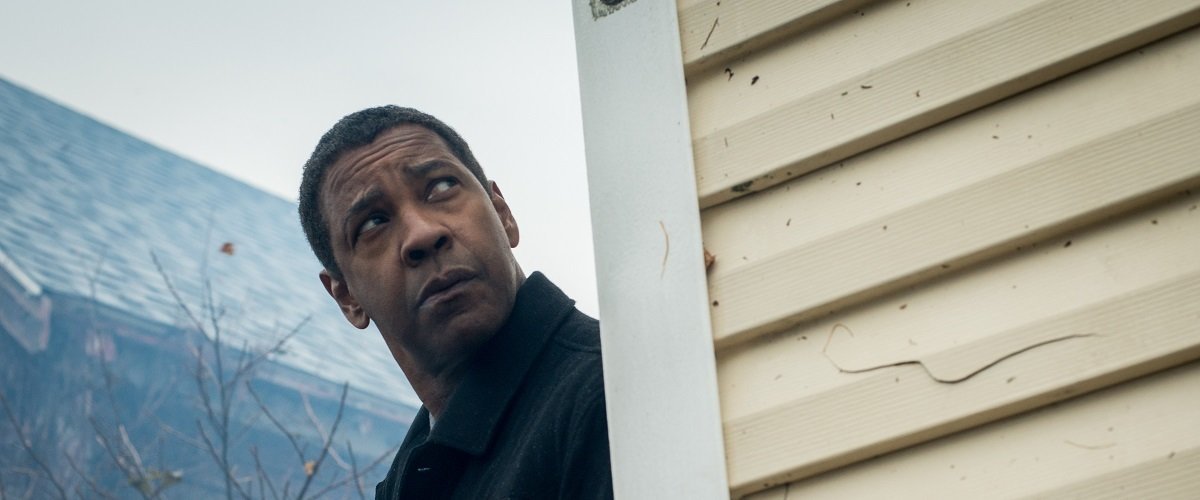
The Equalizer 2 (2018) * * *

Directed by: Antoine Fuqua
Starring: Denzel Washington, Melissa Leo, Bill Pullman, Pedro Pascal, Ashton Sanders, Orson Bean
Like its predecessor, The Equalizer 2 is a slick, polished action thriller elevated by Denzel Washington's performance in the title role. Washington's Robert McCall is a man who observes, listens, and maintains calm even in the face of outfoxing four assassins in a hurricane. He was once in the CIA, but that was many years ago, and for reasons never made clear his death was faked and he now tries to live a quiet, anonymous existence in Boston. The quiet doesn't last long, because even as a Lyft driver, McCall takes it upon himself to right wrongs and provide justice to those who need it.
The movie hints that such acts are ones of penance for McCall, or maybe they are just an excuse to keep the skills he learned in the CIA sharp. He gets plenty of chances to do that, and his skills acquired over a long career put Liam Neeson's in the Taken series to shame. Between two Equalizer films, McCall comes out of them with a small wound on his thigh as the worst of his injuries. Forget Liam Neeson, maybe The Terminator could learn a thing or two from McCall.
The Equalizer 2 never overextends its reach. It doesn't pretend to be anything more than it is. Washington isn't looking for any awards season exposure for his work, he gives us a character who kicks ass and doesn't bother to take names. Washington hints at a deeper history for McCall, and thankfully the movie doesn't expound on it much, but it gives McCall a human dimension. The Equalizer has not one, but three different plots to juggle. McCall not only has to deal with the violent death of one of the two people who knows he's still alive, but also an ordeal from an elderly frequent Lyft passenger who is trying to reclaim a painting stolen by the Nazis, and a wayward teen who lives in his apartment complex clearly headed toward a life of crime.
McCall becomes a father figure to the teen (Sanders) and it would come as a surprise to no one that the kid would be taken hostage by the villains as leverage against McCall. You can ask the Russian gangsters from the first film if such a thing would work, if there were any alive to tell you. McCall is an instrument of violence, with a touch of the Denzel Washington charm which makes him among the most likable and accomplished actors ever. We wind up caring enough to see McCall dispense his brand of justice, and also interested in what creative method he will use to kill his targets. If McCall were dispatched to kill Bin Laden after 9/11, Bin Laden would've been dead by 9/14 in my estimation.
Friday, July 20, 2018
The End (1978) * 1/2
Directed by: Burt Reynolds
Starring: Burt Reynolds, Dom DeLuise, Sally Field, Kristy McNichol, Joanne Woodward, David Steinberg, Strother Martin, Myrna Loy, Norman Fell, Robby Benson, Carl Reiner
It took some nerve for Burt Reynolds, then the world's biggest box-office star, to direct a dark comedy about a terminally ill man who wants to commit suicide. But, The End hedges its bets and turns into silly, unfunny slapstick fare. Maybe this was a doomed project from the start, but the opening scenes at least present us with darkly comic possibilities before Dom DeLuise shows up.
Sonny Lawson (Reynolds) is a man with six months to live who despairs at the idea of dying a painful death. He decides to commit suicide, and after a failed attempt at ingesting sleeping pills, is institutionalized and introduced to Marlon (DeLuise), a schizophrenic who befriends Sonny and wants to help him end his life. It is at this point in which The End sinks. We meet Marlon sitting next to Sonny's bed and talking his ear off. The scene drags on incessantly and we realize a very little of Marlon goes a long way. Too long. It's as if Reynolds did not want to cut the scene short, so he lets it drag on.
Reynolds is of course a charismatic, charming comic actor. DeLuise can be funny with the right role and someone to rein him in, but that didn't happen here. He is allowed to run amok, with increasingly unfunny results which overshadow the entire movie. In addition, we have various scenes in which the characters scream at each other and only increase their loudness as they progress. The scenes in which Sonny attempts suicide with Marlon's help also build and build to no payoff.
The ending turns sentimental, but doesn't save The End from what has come before and it doesn't last long. Maybe there was no way to make this movie work. I suppose theoretically there could be humorous material to be made from this, but The End isn't it.
Mamma Mia!: Here We Go Again (2018) * * *

Directed by: Ol Parker
Starring: Amanda Seyfried, Colin Firth, Pierce Brosnan, Lily James, Stellan Skarsgard, Dominic Cooper, Christine Baranski, Julie Walters, Andy Garcia, Cher, Meryl Streep, Alexa Davies, Jessica Keenan-Wynn, Hugh Skinner, Josh Dylan, Jeremy Irvine
I wasn't waiting for a sequel to Mamma Mia! (2008), which was a slight musical based on the Broadway smash in which big named actors sung ABBA hits in an effort to hold a threadbare plot together. The sequel contains more ABBA songs, including some reimagining of those performed in the first film and I would imagine a raid of some of the deep tracks from ABBA's albums. It has energy, charm, and a Lily James performance you can't keep your eyes off of. I didn't anticipate enjoying it as much as I did, but there it was in all its silly glory daring me to hate it. I couldn't.
Meryl Streep, the lead from the first film, is featured on the poster and in the trailers of the sequel, but she is only in it for about ten minutes near the end and in a version of Super Trouper over the closing credits. The main focus this time is on her daughter Sophie (Seyfried), who was supposed to get married in the first film, but didn't. She is still with the same guy when this story picks up a few years after its predecessor, but it is unclear whether they married after all. Sky (Cooper) is in New York working a new job, while Sophie is renovating her now late mother's hotel for a grand re-opening bash on the same Greek island from Mamma Mia!. Sophie invites her three fathers (Brosnan, Firth, and Skarsgard) to join the shindig, but two of the three can't make because they are halfway around the world on business affairs. No points for guessing they will chuck their plans to travel to the party and surprise their "daughter". I won't explain how exactly Sophie has three fathers. See the first film to find out.
Sophie's reopening is not without its obstacles, and the film cuts often to flashbacks to her mother graduating college in 1979 and then setting out for adventure. Donna (James) is a free spirit looking for love, or at least Mr. Right Now, and her smile lights up the screen. Within a roughly 48-hour period, she hooks up with awkward Harry (Skinner), smooth Swedish sailor Bill (Dylan), and then masculine architect Sam (Irvine) on the Greek island, and has her heart broken by Sam. But, she loves the island and stays there, learning she is pregnant by one of the three men she had relations with along the way and giving birth to Sophie.
James is radiant and the younger versions of Brosnan, Firth, and Skarsgard are also appealing. Harry's version of Waterloo is the musical highlight of the movie, but I doubt there can be a bad version of that song. Meanwhile, back at the hotel in present day, Fernando (Garcia) is the hotel manager who lost track of his love many years ago. No points again for guessing he will reunite with her before the movie's end, as well as having ABBA's Fernando performed to commemorate the event. Sophie's grandmother (Cher) also makes an appearance. In real life, Cher is only three years older than Streep, but she is still billed as Donna's mother and Sophie's grandmother, so we go along with it. No points for guessing Cher will belt out a number or two as well.
The story is thin oatmeal, but the flashback scenes with James carry some gravitas and poignancy which provide the heart of Mamma Mia!: Here We Go Again. Once you get past the silly story and the pretense of characters simply breaking into song at inopportune moments, then you will sit back and find yourself tapping your feet to the songs. I know I did.
Wednesday, July 18, 2018
Shock and Awe (2018) * * *

Directed by: Rob Reiner
Starring: Woody Harrelson, James Marsden, Rob Reiner, Tommy Lee Jones, Jessica Biel, Milla Jovovich, Richard Schiff
With Shock and Awe, Rob Reiner calls out the American media for not doing its job in the weeks and months before the start of the 2003 Iraq War. The Bush administration fabricated stories of Iraq stockpiling weapons of mass destruction, reputable newspapers like The New York Times and The Washington Post published the stories with little if any confirmation of the truth, and thus the costly, deadly war was launched with considerable public and legislative support behind it. The media basically acted as stenographers for the Bush administration press releases without doing its job as a check and balance for the executive branch.
The one news service which dared to publish stories which contradicted the administration's tall tale was Knight Ridder, which at its height published 32 newspapers in the United States. Oddly, these papers opted to publish New York Times or Washington Post articles which backed up the Bush administration's story instead of questioning it. Editor John Walcott (Reiner) is aghast that the Knight Ridder family of newspapers would avoid publishing his journalists' stories. "When the New York Times issues an apology, you can publish that in your papers as well," Walcott tells the publisher of the Philadelphia Inquirer. A short time after the start of the Iraq War, when it became abundantly clear that there were no weapons of mass destruction, the New York Times indeed issued an apology for its shoddy journalism. Not that it was much help to the troops who were already killed or wounded.
Shock and Awe is an angry film. Sure, it is preachy at times, but it has something to preach about. Those who chide the media these days for "fake news" (or news which paints Donald Trump in a bad light) would love the media of Shock and Awe. The media took a nap on its responsibilities following 9/11 until well after the Iraq War was underway. No one but Knight Ridder wanted to rock the boat, preferring to simply publish the spoon-fed official story instead of doing its due diligence to ensure the story is true. Fifteen years after Bush prematurely stated, "Mission Accomplished", American soldiers are still losing their lives in Iraq, which has since plunged into the civil war the insiders who spoke to the Knight Ridder journalists expected as early as 2001.
Shock and Awe begins on 9/11, and shortly after, there were rumblings around Washington that Iraq was being targeted as the nation responsible for the attacks. The story was being formulated that Saddam Hussein was providing aid and shelter to Al-Qaeda, but those who knew the Middle East know of Hussein's long-standing hatred for the terrorist organization and that such a connection was bunk. No matter. The Bush administration slowly whipped up support for an invasion, with help of a sleeping media and an uninformed American public who only wanted someone, anyone to pay for 9/11. Attacking Iraq over 9/11 was akin to Moe slapping Larry, who in retaliation slaps Curly.
The movie does not make the case that Hussein was an innocent. He was a cruel dictator who vanquished the lives of thousands of his people. But, he had no connection to 9/11, which is something the Knight Ridder journalists led by Jonathan Landay (Harrleson) and Warren Strobel (Marsden) are uncovering. This is not a popular story, and they must stand by in frustration as the popular version of events makes headlines, while the truth languishes. There was no room for anything which would be viewed as "unpatriotic" in the days following 9/11. Nor any room that might suggest Hussein had no part in those events.
Shock and Awe does not operate as if it is occurring in the moment without the benefit of hindsight. Reiner clearly wants to state his case and does so effectively. A few subplots, such as Warren's budding romance with his neighbor (Biel) are extraneous, but the message hits home. Because the Trump administration is a dumpster fire so far, it has become popular to somehow romanticize the George W. Bush administration as the good old days. Reiner reminds us that this is not so, especially when, like Vietnam, thousands lost their lives over an unsubstantiated lie. The families of lost loved ones would not be so quick to give Bush a pass. Neither does Rob Reiner; and he asserts the media is every bit as culpable as Bush. We can't say he's wrong.
Tuesday, July 17, 2018
7 Days in Entebbe (2018) * *

Directed by: Jose Padilha
Starring: Daniel Bruhl, Rosamund Pike, Eddie Marsan, Lior Ashkenazi, Denis Menochet, Angel Bonnani, Juan Pablo Roba, Nonso Anozie
The ingredients are all here for a tense, suspenseful thriller based on the true story of the 1976 Air France plane hijacking by terrorists. However, a great deal of the movie involves the people on both sides standing around waiting and thinking about what to do next. It stands still when it should be in motion, pushing ever forward to its payoff. Instead, we witness people pondering their next move and wrestling with their consciences. It is not exactly a worthwhile cinematic experience.
7 Days in Entebbe begins with a brief history of violent relations between Israel and neighboring Palestine explained in the opening titles over an Israeli dance company's performance of Naharin's "Echad Mi Yodea". When Israel was formed following World War II, Palestinian land was taken to create the new Hebrew state in the Middle East, inflaming hatred, violence, and tension in the region ever since. The hijacking takes place four years after the slaughter of eleven Israeli athletes by a Palestinian terrorist organization, and the Israeli government led by Prime Minister Yitzhak Rabin (Ashkenazi) stands by Israel's policy not to negotiate with terrorists. The terrorists are a mix of German and Palestinian "freedom fighters" led by Germans Wilfried Bose (Bruhl) and Brigitte Kuhlmann (Pike). Their goal is to hold the 250 passengers (83 of them Israeli nationals) ransom in exchange for the release of political prisoners in Israel. This, they believe, will strike a blow against Israel.
It is not lost on Kuhlmann and Bose that they are Germans committing horrific acts against Jews, but they manage to separate their cause from that of Nazism...at least in their minds. When Israel learns of the hijacking, Rabin battles with his conscience, his cabinet led by defense minister Shimon Peres (Marsan), and the families of the hostages who only want their loved ones home safe...Israeli policy be damned. The waters are further muddied by the terrorists keeping the hostages in an abandoned airport terminal in Entebbe, Uganda, with Idi Amin (Anozie) promising to take care of the hostages while in fact harboring terrorists; a move which would turn international opinion against him.
Peres and Mossad propose a midnight raid to save the hostages. Rabin is not so sure. He leans towards negotiations and then away from them. "If I were still a general, I would not approve this raid. It is too risky," says Rabin, but with cabinet pressure mounting to take action, Rabin relents and Operation Thunderbolt is under way. By the time the military action is in full swing, 7 Days in Entebbe has not gathered any momentum or tension. Except for the plane's engineer (Menochet-- in the film's best performance), we learn little or nothing about the hostages and only slightly more about the terrorists themselves. There are dialogue scenes about their doubts about their mission and about the Israeli intentions, but nothing which would cause us to care all that much. Even Amin's scenes are muted. He is the wild card, balancing international perception while trying to stay in favor with his allies, but he is mostly left on the sidelines.
7 Days in Entebbe manages to document this event without engaging us in it. It feels more like a footnote in the ongoing battle between Israel, Palestine, and the rest of the Middle East. We get the feeling this was just one of many fights to come between these factions. The hijacking didn't seem to represent a turning point of any kind. The PLO led by Yassir Arafat had yet to become a major player and 7 Days in Entebbe feels like just what it is....the end of the beginning.
Monday, July 16, 2018
Live by Night (2017) * *
Directed by: Ben Affleck
Starring: Ben Affleck, Zoe Saldana, Chris Messina, Chris Cooper, Elle Fanning, Sienna Miller, Brendan Gleeson, Robert Glenister, Remo Girone
Live by Night never achieves liftoff. Director Ben Affleck wants us to really like his protagonist, which is fatal to a film about a violent mobster working his way up in the Boston mob. At times, Joe Coughlin (Affleck) is a gun-toting killer, at other times a softie romantic, and at other times moral and upstanding. Instead of a multi-dimensional character, Joe Coughlin feels more like a prisoner of the screenplay. If the movie doesn't know what to think of him, then how can we?
Live by Night has moments in which it starts to connect and the story appears to be moving forward, but these are islands unto themselves. The film has a cogent feel for its time and place and looks right, but at times feels like a saggy season four episode of Boardwalk Empire. The production values nor the actors can be blamed, just its directionless plot and main characters which stops and starts when it should soar.
Until this film, Affleck was batting three-for-three in the director's chair. Argo, 2012's Best Picture, was a gripping, taut, and suspenseful film based around the Iran Hostage Crisis. Live by Night is only occasionally gripping and suspenseful, and takes a lot longer to tell its story than is necessary. As Live by Night opens, we learn Joe is a World War I veteran who has seen plenty of war horrors and is determined not to take orders from anyone again. This delusion doesn't last long as he turns to a life of crime. He robs banks with help of trusted cohorts like Dion (Messina), but soon the Irish mob boss in town, Albert White (Glenister) wants his cut. Coughlin begins working for White despite having a police superintendent father (Gleeson), who naturally disapproves of his son's career choice and his affair with Emma (Miller), who is White's mistress as well. We know that won't end well, although it doesn't end as badly as you would think.
Joe is soon pinched for a botched robbery which left cops dead. He does a generous three-year prison stretch and upon release goes to work for White's Italian rival Masso Pescatore (Girone), who sends Joe to Florida to turn around the sinking illegal booze and narcotics trade there. With Emma now out of the picture, Joe falls for Graciela (Saldana) and marries her, although there isn't a lot of screen time dedicated to their romance to make it truly compelling. In Florida, Joe runs afoul of the local KKK, the town's police chief Figgis (Cooper), and the chief's daughter Loretta (Fanning), who travels to Hollywood with dreams of stardom and comes home a recovering heroin addict who finds Jesus and whips up public support against Joe's proposed casino.
Joe impractically orders Loretta not to be touched, which doesn't sit well with Masso (who wants to see gambling legalized in Florida and the casino built). The movie doesn't say why he draws the line with her. Are there spiritual elements to Joe which were fleshed out more in the Dennis Lehane novel on which this film is based? We don't know, but at first Loretta is an enemy then in a 180 degree plot twist, becomes a depressed doubter of her own faith who confides in Joe about her issues. Loretta conveniently exits the film, but not before we scratch our heads at the twists and turns of her character which didn't quite fit.
Affleck is at home in the role and maybe he has ideas about Joe that don't translate to the screen. At times, Affleck plays the role of a 1920's gangster with too much of a contemporary vibe, but we focus more on our ambivalence toward him. There is plenty of gun violence, explosions, fights, and double crosses which are part of any gangster epic, but Live by Night never builds on the scenes which work. It wants to be a memorable crime film, but it knows the words and not the music.
Subscribe to:
Posts (Atom)