Monday, December 17, 2018

The Mule (2018) * * *

The Mule Movie Review


Directed by:  Clint Eastwood

Starring:  Clint Eastwood, Bradley Cooper, Dianne Wiest, Michael Pena, Alison Eastwood, Taissa Farmiga, Laurence Fishburne, Andy Garcia, Ignacio Serricchio

After the disastrous The 15:17 to Paris from earlier this year, Clint Eastwood returns to his superior filmmaking form in The Mule, which casts Eastwood himself as the titular octogenarian drug mule.    Even if The Mule doesn't reach the emotional heft of Eastwood films like Sully, Million Dollar Baby, Unforgiven, and the underrated True Crime, it still works amusingly and touchingly. 

Eastwood circles around to a theme similar to Sully (2016):  Even all the technology in the world is no substitute for experience.    Eastwood's Earl Stone is a careful driver who has never had a ticket or been stopped by police.    This and his financial desperation after the closing of his daylily farm makes him an ideal candidate to run kilos of cocaine from Texas to Illinois on a monthly basis for a Mexican drug cartel.    Earl never thought his life would take such a bizarre turn.    The Mule opens in 2005, with Earl attending a flower convention where he is the life of the party.    The convention occurs the same day as his daughter's wedding, and Earl chooses the convention over the wedding, leading to his daughter not speaking to him for over twelve years.    Earl comes to an oft-expressed realization that he put work above family, something which his long-suffering (now ex) wife Mary (Wiest) concluded a long time ago.  

Earl at first doesn't realize he is transporting drugs, probably because he doesn't want to know, but these deliveries net him more money than he's ever seen, and allows him to pay for his loyal granddaughter's school tuition and repairs to the local VFW.    Things are going well.   Earl is delivering the goods and the cartel boss Laton (Garcia) is happy, even though Earl tends to make stops to visit old friends and eat more often than he should.    Laton is quite reasonable and understanding as drug cartel bosses go, which leads to unforeseen plot turns which endanger Earl's life.    Laton is soon replaced by a tougher boss, who demands deliveries on time and sticking to the assigned routes...or else.

The shipments are tracked by DEA agent Colin Bates (Cooper), who wants to deliver a big bust so he can be promoted.    But Earl unwittingly manages to elude Bates as Bates tracks a black pickup track prowling the highways between Texas and Illinois.     Bates uses plenty of money and resources to track Earl, much to the consternation of his boss (Fishburne) who wants to see high-profile arrests at the end of all of this spending.    There are some contrivances which allow Earl and Colin to talk frankly about family in a Waffle House, with neither knowing who the other is, but these scenes work anyway.  

Eastwood still commands the screen as only he can, even though he is showing his age and his tall, lean frame is hunched over.    He gives Earl the right of amounts of crustiness, knowhow, experience, and even an ability to still learn and grow.    His scenes of reconciliation with his family (we know the movie can't end with Earl still being estranged from them) provide the emotional gravitas the film requires, even if such a detour may cost him his life.    I also enjoyed his interactions with his "handler" Julio (Serricchio), who is clearly miserable having to babysit Earl on his runs.  

The Mule is "inspired by a true story".   Maybe the story went this way, or maybe it didn't, but Eastwood surely found something in it to inspire him to return to the screen for the first time in six years.   Eastwood will turn 89 in May, and I can't help but wonder how many more times we will see him onscreen or behind the camera.    He is a durable movie star who is also a master director, with very few clunkers in his nearly fifty-year directing career and sixty-plus year acting career.    The Mule represents a story which touched him personally and he needed to tell it as only he can.   


Tuesday, December 11, 2018

Rope (1948) * * * 1/2

Rope Movie Review

Directed by:  Alfred Hitchcock

Starring:  Jimmy Stewart, Farley Granger, John Dall, Cedric Hardwicke

Rope is not among the first movies which comes to mind when Alfred Hitchcock is mentioned, but it is a supreme example of his love of suspense.    The mechanics for a suspenseful evening are simple:   Two men, Brandon and Phillip (Dall and Granger) strangle an "inferior" friend and hide his body in a trunk which will soon serve as a centerpiece at a party in the very apartment where the murder was committed.    The two murderers could've disposed of the body earlier perhaps, but part of the fun for them is getting away with murder while the body is right under everyone's nose.    Well, part of the fun for Brandon anyway.    Phillip is guilt-stricken, while Brandon walks around with a smirk like the cat who ate the canary.    They partially hope they will be caught, but only by Rupert (Stewart), their former prep school professor who lectured often about the supposed superiority of the intellectual class.   What a thrill it would be for them to see how they've twisted Rupert's words to mean something darker or more evil than intended.

Hitchcock experimented with longer cuts and different camera takes than in his previous or later films.    The camera is consistently moving in one sustained cut, which at times is noticeable, but not fatally so.    At one point, Hitchcock has to keep the camera behind a seat in order to rewind and continue the seemingly unbroken shot.    Film making tricks aside, Rope sinks or swims on its story, based on a play which was inspired by the infamous Leopold-Loeb case.    In reality, the murderers were homosexual lovers.   In Rope, their relationship is hinted at, but not exposed due to anti-decency laws in effect for motion pictures at the time.  

The famed director was not happy with his finished product and kept it out of theaters for decades, finally seeing re-release in 1984, four years following his death.    Rope succeeds due to the plot's sheer audacity.    We know the party guests are placing their drinks down on the trunk which hides the victim's body, but they don't, and there is a macabre suspense at work.    The guests inquire about the missing guest, and Brandon delights in posing theories as to why he isn't at the party.    Rupert, however, grows suspicious when the two men keep contriving ways to keep him away from the trunk.   But, even in his wildest dreams, he couldn't imagine his two prized students murdering someone, because that's human nature.    We can easily suspect a stranger of murder, but not a friend or relative.   The party guests also don't assume the worst, because no one wants to believe their friend/son/fiancĂ© is no longer with us thanks to foul play.

Rope enjoys dangling the possibility of discovery in front of us, only to pull it back again.    The murderers are sufficiently malevolent, but Stewart, who despite playing a man with bad ideas which can easily be misconstrued or malleable, is who we hope would be the person who discovers the body.   Stewart may not be the ideal candidate to play a professor who espouses theories on intellectual superiority, but since he's Jimmy Stewart, we let it slide.   The final fifteen minutes are a verbal cat-and-mouse game, in which Rupert feigns leaving his cigarette case in the apartment just to confirm if his suspicions are correct.    He toys with Brandon's ego and Phillip's guilt, causing Phillip to scream, "It's cat and mouse, only who is the cat and who is the mouse?"    Rupert's discovery not only leads to something dreadful, but also the guilty understanding that his philosophies are not ones which should be thrown around lightly, because homicidal men may take them too far.    In that sense, Rope remains relevant even today, seventy years after it was made. 


Shutter Island (2010) * * * 1/2

Shutter Island Movie Review

Directed by:  Martin Scorsese

Starring:  Leonardo Dicaprio, Mark Ruffalo, Ben Kingsley, Michelle Williams, Jackie Earle Haley, Max von Sydow, Patricia Clarkson, Ted Levine

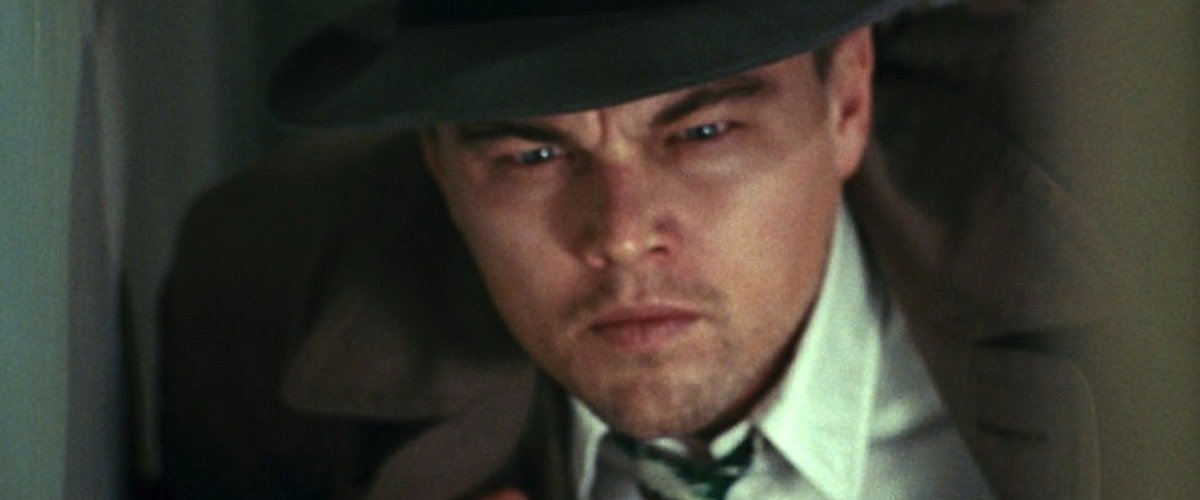
We first encounter U.S. Marshal Teddy Daniels (Dicaprio) meeting his new partner Chuck Aule (Ruffalo) as they take the ferry to remote Shutter Island, which houses the Alcatraz of mental institutions.  This is my description, not the movie's.  When you witness the cold, dark halls, the dank basement imprisoning the most violent offenders, and the craggy rocks acting as a natural barrier to the foreboding waves of the sea crashing into them; the allusions to Alcatraz are inherent.   It seems nearly impossible for someone to escape the island, but Teddy and Chuck are investigating an institutionalized child murderer who has gone missing.   

Teddy may not have been the best choice to send to Shutter Island.    He is a man haunted by his past and his visions of the Dachau concentration camp which he helped liberate near the end of World War II.    Hallucinations of a young woman and her child follow him, and Teddy believes by finding the escaped child murderer he will somehow free himself of his past.    A simple investigation delves into darker, seedier aspects of the island itself.    Is the hospital conducting secret experiments on its patients?    Is the island part of a greater, more sinister plot?    Teddy and Chuck want to find out, but one wonders how far they are willing to risk their sanity to accomplish their goal. 

Martin Scorsese may not seem to be the ideal director to examine the horror show that is Shutter Island, but he is the ideal director to delve into what tortures Teddy.   We know there is more to the story, but we can't pinpoint it, except that what is tormenting Teddy's psyche has little to do with experiments or evil doctors.   Teddy just barely clings to his sanity as he runs into dead ends following by illuminating clues, but we inquire how much sanity he had to begin with.    Have the pressures of the job combined with the horrors he has witnessed finally cracked him? 

Dicaprio is a sympathetic center for Shutter Island.  We feel the walls of the place closing in on him even if we aren't exactly sure why.  There is the terrifying feeling he may soon be engulfed by the institution, with the ferry to freedom not too far off in the distance.   The investigation itself soon devolves into a morass of twists, turns, false starts, and false finishes.  One clue leads nowhere, while another may lead somewhere Teddy may be reluctant to go, but he must venture there if he is to discover the truth.   Chuck (Ruffalo) seems immune to the craziness of the island.    He views Teddy's struggle as a distant outsider, and maybe because his professional duties dictate that he must.

The man who holds the key is Dr. Cawley (Kingsley), whose benevolent personality may conceal sinister intentions, or hold the key to the truth of Shutter Island.  Even in the face of an investigation and caring for the most violent of the criminally insane, he remains unflappable.  How could this be?   Isn't he the least bit concerned that a U.S. Marshal is investigating a disappearance from his inescapable institution?   It appears no, and there are reasons why this is.  The clues and red herrings are soon tidied up, but not happily.  This is not a movie meant for a happy ending, but instead for a plausible explanation which may shock some viewers on first viewing, but upon second viewing makes sense of all of the names, faces, and visions flying around.    Is Shutter Island among the best of Scorsese's films?    No, but it is well-crafted and has the courage to stay on its path, no matter how sad it is.   


Saturday, December 8, 2018

Instant Family (2018) * *

Image result for instant family movie pics

Directed by:  Sean Anders

Starring:  Mark Wahlberg, Rose Byrne, Isabela Moner, Margo Martindale, Joan Cusack, Gustavo Quiroz, Jr., Julianna Gamiz, Octavia Spencer, Tig Notaro

Before the end credits began rolling on Instant Family, a website promoting foster parenting was flashed onscreen.    If what happens in Instant Family is any indication of what truly happens when becoming a foster parent, then count me out.    The biggest of the many issues surrounding Instant Family is that it doesn't know what kind of movie it wants to be.    When it wants cheap laughs, Juan (Quiroz) is brought on to have a ball violently hit him in the face or a nail gun drop and impale a nail into his foot.    When it wants to be all serious, the oldest foster child Lizzie (Moner) is trotted out to start an argument or behave like a brat.    I do not doubt the confusing gamut of emotions a foster child bounced around the system must have, but Lizzie is too much.    She isn't confused.   She's bi-polar.

Instant Family never masters its tone.   It goes from slapstick to sentimentality so quickly in the same scene at times we encounter possible whiplash.    We wonder why Pete (Wahlberg) and Ellie (Byrne), who are a nice childless couple, would want to sign themselves up for this.   I'm not supposed to feel this way, but their lives were better off without all of the drama these kids bring into their lives.    If the movie is to be believed, foster parenting is a prerequisite for sainthood.    I have no doubt foster parenting is challenging, but it must be rewarding on some level.    Instant Family tries to make the argument that there are rewards, but it never convinces me or itself that there are any.

Pete and Ellie flip houses for a living, and business is good.   But because they are childless, they feel empty.   They live in a nice house with just each other, and decide to solve their empty nest dilemma by adopting a trio of siblings.    Pete and Ellie go through a foster parent training course, and are told of the system's positives and negatives by Octavia Spencer and Tig Notaro, who garner the movie's biggest laughs with their byplay and their expertise.    I can't fault the performances in Instant Family, just the fact that they are at the service of a movie which doesn't move the needle emotionally even when it is trying desperately to do so.

Pete and Ellie encounter the most trouble with the rebellious Lizzie, who wants to fill her own emotional void by reconnecting with her ex-con, drug addicted biological mother against the wishes of Pete, Ellie and her younger siblings.    Juan's scared, overly deferential behavior is never dealt with.   Why is he so frightened?   Or accident-prone?   The movie doesn't explore that.   Instead, it focuses on Lizzie, who is unpredictable, angry, and not just troubled, but Troubled.   She doesn't garner much empathy, and that is fatal to the movie.    There is a key moment in which Lizzie runs away after hearing some bad news about her mother, and by this point, and I know I'm probably a churl for feeling this way, I was hoping Pete and Ellie would use this as a get out of jail free card.    Joan Cusack shows up at a wacky neighbor who seems desperate for any human contact.    I enjoy Joan Cusack's work, but why have her show up in only the final ten minutes of the movie?    More could've been done with her.

Instant Family wants to spread an honest message and it can't be faulted for trying, but this isn't the stuff of comedy.    It should've delved into the issues it raises instead of sidestepping them or glossing over them on the way to a forced happy ending.     Maybe director Anders, who based this story on his own real-life experiences, hedged his bets by throwing in slapstick when things got too uncomfortable.    It's a pity Instant Family, like Pete and Ellie themselves, just wants to be loved.


Lean on Me (1989) * * *

Image result for lean on me movie pics

Directed by:  John G. Avildsen

Starring:  Morgan Freeman, Beverly Todd, Robert Guillaume, Alan North, Lynne Thigpen, Robin Bartlett, Jermaine Hopkins

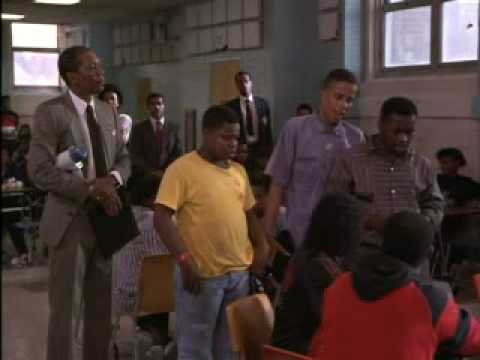
I preface this review by stating I wasn't a fan of the Joe Clark presented in this film.   Some of the other people in the movie feel the same way:   He is a tone-deaf, egotistical bully who demands respect without giving it and doesn't change much during the course of the movie.    Despite that, I loved watching Morgan Freeman jump into the role with passion and energy.    It is based on a true story, but something tells me the only similarity between the real Joe Clark, who did indeed turn around a struggling New Jersey high school, and this one is the name.   

The Joe Clark of this movie is tough to deal with, but at least the movie understands that and doesn't pretend he isn't.    One character calls him a bully and a despicable man, while another says he is thoughtless and cruel.  All of those descriptions are accurate, but Freeman makes him compellingly watchable.  We also are treated to a masterful scene in which Clark's superintendent boss (and likely his only friend on Earth) lays down the law with him as he makes enemies of the mayor, school board, and parents.  ("Contrary to popular opinion, I'm the head n***** in charge")   

When we first encounter Eastside High School, it is a cesspool of drugs, violence, terror, and despair.   The cafeteria is caged in with fences, and no learning of any consequence takes place.   Superintendent Dr. Napier (Guillaume) is faced with the real possibility of having the state take over the school if the students are unable to pass its year-end proficiency test scores.  My thoughts?  Let the state inherit this headache. But, then there wouldn't be a movie, so Napier calls on his old friend Joe Clark to become principal and whip the school into shape.  Clark has a history of defying authority and personal troubles, but Napier feels he is left with no alternative.   Clark is his Hail Mary pass. 

Clark behaves like a dictator towards the staff.   ("This is not a damned democracy and my word is law,"), but he does expel over 300 students who caused nothing but trouble in school and slowly but surely makes the place look more a high school and less like hell.    Clark suspends a loyal teacher who picks up a piece of trash off the ground during one of Clark's speeches.    He fires a music teacher who stands up to his tyranny.    The biggest mistake Lean on Me makes is trying to force us to sympathize with Clark.    He isn't one we can really root for, but he's still fascinating.    John G. Avildsen, who of course directed Rocky, applies the same theme here.   He treats the preparations for the state tests in almost the same manner as Rocky training for the title fight, and I can't say I was bored.    This has to be the goofiest, most ambivalent three-star review I've ever written.  

Thursday, December 6, 2018

The Firm (1993) * * *

Image result for the Firm movie pics

Directed by:  Sydney Pollack

Starring:  Tom Cruise, Gene Hackman, Ed Harris, Jeanne Tripplehorn, Wilford Brimley, David Strathairn, Holly Hunter, Gary Busey, Terry Kinney, Hal Holbrook, Steven Hill

The film version of The Firm replaces John Grisham's novel's cynicism with idealism and a moral center in Mitch McDeere (Cruise), a Harvard law graduate from a poor background who is the ideal recruit for the Memphis law firm of Bendini, Lambert, and Locke.    Why is he ideal?    Because after being pitched with a new home, a big starting salary, flashy car, and some downhome folksiness, Mitch accepts the job even though he could have his pick of firms in New York.   He is hungry for the life he never had growing up.    Major mistake.   Mitch soon realizes his firm isn't what it seems, and he is caught in a web involving the firm and the FBI which will take some ingenuity to free himself from.  

The Firm is a legal thriller that hums along.    Despite the moving parts, it mostly makes sense, but even Mitch's plan to outwit the firm and the FBI leaves an awful lot to chance.    No matter.   We want Mitch to succeed in his plans and for the firm to go down in flames.    The firm, as we learn, is a money laundering operation for the mob and kills associates who want to leave or spill the beans.    With the exception of Mitch's mentor Avery Tolar (Hackman), the firm consists of amoral lawyers who protect their interests by any means necessary.   Hackman effectively plays a conflicted man who was once a fresh young idealist like Mitch, until the firm got a hold of him and sucked out nearly all of his humanity.    But because Avery is played by Gene Hackman, we know he has a soft spot in his heart for Mitch and especially for Mitch's schoolteacher wife Abby (Tripplehorn), who suspects something is amiss in the firm long before Mitch does.

The FBI, led by Agent Wayne Terrance (Harris), doesn't provide a comfortable alternative to working at Bendini, Lambert, and Locke.    They want Mitch to copy files, betray client secrets, and subject himself to life in the witness protection program sans a license to practice law.    Mitch, we learn, has some secrets of his own including a brother in jail serving time for manslaughter he didn't tell the firm about during his job interview.    Through his brother, Mitch hooks up with a chatty private eye (Busey), who notes, "the lawyers at your firm sure do seem accident prone,"   But the private eye meets a messy fate, and his secretary/lover Tammy (Hunter) aids Mitch in his plan.

How precisely Mitch worms his way out of his predicament I will leave for you to witness, but don't blink or you may miss something.    The actors clearly are enjoying themselves, anchored by a sympathetic Cruise.    Director Pollack keeps the pace taut even for a nearly two-and-a-half-hour movie, with the stakes clearly spelled out.    It would be difficult not to note the simple, yet effective Dave Grusin piano-based score, which underlines the thriller aspects nicely while suggesting that this is all fun to watch unfold.

Wednesday, December 5, 2018

The Jerk (1979) * * *

Image result for The Jerk movie pics

Directed by:  Carl Reiner

Starring:  Steve Martin, Bernadette Peters, Carl Reiner, Mabel King, Richard Ward, Bill Macy, M. Emmet Walsh, Catlin Adams

Maybe The Jerk isn't an apt description of Navin Johnson (Martin).   He is more of a simpleton, a doofus, or slow on the uptake.   Otherwise, he is an eternally optimistic guy mostly because he isn't exactly bright enough to figure out what's going on around him.    For example:  A gun-toting madman (Walsh) picks Navin's name out of the phone book and targets him for death.    He tracks Navin to the gas station where he works and begins firing.    The shots hit the cans of oil on display, but not Navin, so Navin deduces, "He hates these cans!"   Navin is a nice guy, but a bit dense.  

It takes Navin years to realize he was adopted even though he is white and his family is black.   But, he takes this news as an opportunity to leave his family's shack in the South and venture West to stake his own claim in the world.    The Jerk is an amusing comedy with more hits than misses with its barrage of both verbal and visual gags.    Navin may be a goof, but he's likable and played with an eternal grin by Steve Martin, in his first feature-film starring role.    Martin would team again with director Carl Reiner in Dead Men Don't Wear Plaid (1982), The Man with Two Brains (1983), and All of Me (1984), with the two former films relying on laff-a-minit gags while All of Me succeeds as a slapstick love story with the soul of Lily Tomlin inside Steve Martin's body.

Navin falls for Marie (Peters), who at first leaves him because he's dopey, but then they reunite and marry after he hits it big as the inventor of Optigrab, a small piece of metal which prevents eyeglasses from sliding down your nose.    Navin and his money are soon parted, as he and Marie spend money on a grotesquely lavish mansion and are suckers for anyone who comes in looking for a hand out.    A priest from Mexico shows Navin a film of "cat juggling" (Martin is also the cat juggler in the seedy film) and Navin whips out the checkbook.    The Optigrab itself is a huge success, until its side effects are publicly revealed by none other than Carl Reiner himself, who blames the Optigrab for a tragic movie set accident.    "It's not about losing the money," Marie whines, "I just don't want to lose all the stuff,"

The Jerk throws gags and jokes at the wall at a dizzying pace, but it mostly succeeds because it is often more funny than not.    Martin's career was launched and over the years has proven to be not just a brilliant comic actor, but an actor with depth in movies like Planes, Trains, and Automobiles and LA Story.    We've seen him evolve since The Jerk, but The Jerk was a good start to a distinguished movie career.