Friday, July 17, 2020

Da 5 Bloods (2020) * * *


Directed by:  Spike Lee

Starring:  Delroy Lindo, Chadwick Boseman, Jean Reno, Jonathan Majors, Paul Walter Hauser, Isiah Whitlock, Jr., Clarke Peters, Melanie Thierry, Norm Lewis

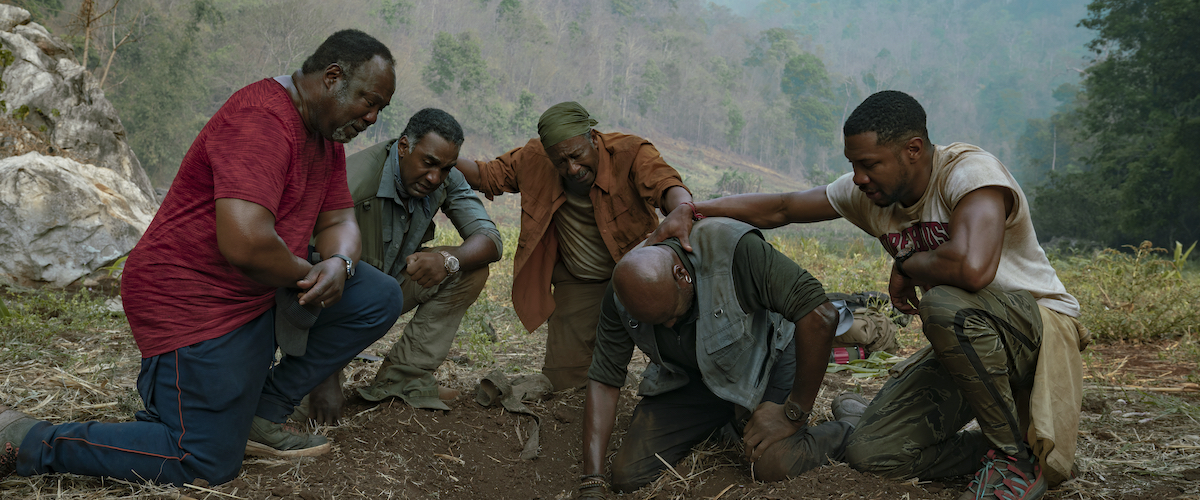
Nearly 33 percent of American soldiers in Vietnam were black; fighting for a country that had not even established full equal rights for them.   This is not lost on the soldiers, either then or now, and with race relations again at the forefront of American consciousness, Da 5 Bloods is timely and relevant.   It is uneven in the first half as it tries to shoehorn a treasure hunt subplot into a more thoughtful story of four black Vietnam vets who return to Vietnam to search for the remains of their fallen comrade and a shitload of gold.   But once it gains its footing, Spike Lee's Da 5 Bloods has some powerful things to say about the black soldiers' relationship to Vietnam.

We meet Da 5 Bloods, (the nickname coined by the unit itself) in present day Vietnam, which with McDonald's, stores, bars, and neon lights punctuating the streets looks like any other modern day city.    The group consists of Paul (Lindo), who is filled with rage and unresolved issues about his time in the war, Otis (Peters), who learns he fathered a child with a Vietnamese sex worker years ago, Eddie (Lewis), a seemingly wealthy man nowadays, and Melvin (Whitlock), who is more the cutup of the group.   Their beloved squad leader Norman (Boseman) was killed in a gun battle years ago, but not before he and the group discovered a downed CIA plane containing a chest of gold bars worth millions today.   In anticipation of their re-discovery of the gold, the men consult a shady banker (Reno), who for a commission will transfer the gold to cash which with they can safely leave the country.  This doesn't go as planned, and neither does anything else as the men wade deeper into the Vietnamese jungle more than fifty years after last leaving there.

Lee cuts in grainy flashback footage of Norman and the squad's trials in Vietnam.   Norman is the voice of reason, and a sturdy leader whom the men look up to.   When Martin Luther King is assassinated, it is Norman who calms the others down enough so they don't run off half-cocked looking for a battle as an outlet for their anger.   What's unique about the flashbacks is that nothing is done to de-age the men a la The Irishman.   They look as they do today, which is effective in terms of continuity and perspective. 

Naturally, word of the lost gold gets out, and Da 5 Bloods are hunted by mercenaries who want the gold for themselves.    These scenes are capped off by violence which almost feels more at home in a Chuck Norris Missing in Action or Rambo movie (which the guys skewer as unrealistic white guy attempts to right a wrong which was Vietnam).    Once the fate of the gold is established, Da 5 Bloods sets its sights on the men making peace at long last with their experiences in Vietnam, especially Paul, whose anger and nightmares are fueled by a sad chain of events long ago.    Lindo's performance is the best in the film.   His character is given the most depth, and Lindo makes the most of it in perhaps his career-best role in a career filled with memorable character turns.   I also enjoyed Boseman's quiet power.  

Lee also spices in footage of Muhammad Ali and Martin Luther King, both of whom opposed the war for different reasons.    Ali saw no reason to fight in a war against Vietnamese people he had no quarrel with (which led to his famous exile from boxing and a Supreme Court case), while King opposed any show of violence, especially one in which others will die thousands of miles away.   We see a snippet of a King speech dated April 4, 1967 in which he spoke out against the war, exactly one year before his death.   This puts the speech into chilling context, as does Lee's shot at Trump, calling him President Fake Bone Spurs, underlying the outrage over Trump exerting his privilege while many others did not have such a luxury. 

What becomes of the men and the gold?   I won't dare say, except that the men exhibit altruism by not merely enriching themselves, but communities and causes which could use the money more than men in their 70's.   Paul's son David (Majors), who goes along for the journey in order to reconnect with his father who has cast him aside for unknown reasons, also benefits by finally learning the truth about his dad, how much he was right about him, and how he was also wrong.    Is Lee's project a bit far-reaching and trying to cover too much ground?   Perhaps, but Lee has never been a filmmaker afraid of pushing boundaries and saying what needs to be said in heartfelt, angry, and ultimately hopeful ways.   Lee shows us how we all messed up in the past in hopes of moving towards a brighter and more unified future. 


Thursday, July 16, 2020

Burden (2020) * * *


Directed by:  Andrew Heckler

Starring:  Garrett Hedlund, Forest Whitaker, Tom Wilkinson, Andrea Riseborough, Usher Raymond

The opening moments of Burden chillingly pull a fast one on the audience.   A group of people, seemingly a family, renovate a small Southern town movie theater which was closed long ago.   "It's about time someone did something with that theater," a black town resident says.    When the overhaul is completed, it turns out the group is actually made up of KKK members and is opening a museum honoring the Ku Klux Klan.   This will not do, and local pastor David Kennedy (Whitaker) organizes daily non-violent protests of the museum, for obvious and legitimate reasons.

Burden tells the story of how one of the Klan members, Mike Burden (Hedlund) soon leaves the Klan and embarks on a journey toward renouncing his racist past with the help of his girlfriend Judy (Riseborough) and Rev. Kennedy, who takes Mike in when the Klan starts exercising its influence and has Mike evicted from his home.   The story has an inherent power, and that pulls the movie along even at it treads on uneven ground.    Mike's transformation is never a smooth one.   He feels the pull of his father-figure Klan leader Tom Griffin (Wilkinson), and is full of mistrust, confusion, and anger.    It is a tribute to Hedlund's performance that he is able to inhabit Mike fully as a man uncomfortable in his own skin.  He walks and moves as if he is trying to shed his exterior and reveal someone else underneath, and expresses himself more physically than verbally. 

Sometimes, Mike's racist attitudes rear their ugly head, and Judy and Rev. Kennedy try and stay the course.   Rev. Kennedy's family is rightly unnerved about having a Klan member, former or not, staying in their home.   To Rev. Kennedy, taking in Mike when he needs help is the prime example of putting God's teachings into action.    I enjoyed Whitaker's work here.   Rev. Kennedy isn't just a pious man, but a compassionate and courageous one who sticks strictly to non-violent teachings, believing they would prevail in the long run.   The question is:  Are others willing to be patient enough to see the big picture?   And how long would Tom let all of this go on without resorting to cruel violence himself? 

Burden tells a story we've seen before (American History X for example, in which Edward Norton's skinhead sees the light after spending three years in prison) and unlike the latter film, Burden is based on true events.    And let's not forget the power and conflict in Riseborough's Judy.   She loves Mike, but detests his past and strives to be the wedge between Mike and Tom.   She cannot abide by Mike being a Klan member, and slowly chips away at him until he decides he loves Judy more than racism and being part of the Klan.   The movie is predictable, sure, and we are uncomfortable watching some of its passages, but it's not an unworthy story to tell. 


The Old Guard (2020) * *


Directed by:  Gina Prince-Bythewood

Starring:  Charlize Theron, KiKi Layne, Matthias Schoenaerts, Luca Marinelli, Marwan Kenzari, Harry Melling, Chiwetel Ejiofor

The heroes of The Old Guard are immortal, or at least immortal up to a point, if that makes sense. 
Led by Andy (Theron), the group of immortals have battled evil and fought in wars throughout the centuries.   Here's how immortality works:   You get shot up, cut up, wounded, maimed, etc. and you're out of commission for a few moments before you wake up and your wounds heal.   The newer you are to being immortal, the quicker you heal up and are as good as new.   The older you are, it takes longer to heal, and one day, you may not heal at all.   At that time, you're no longer immortal. 

The explanation is reasonable enough and we proceed on.   Andy has dreams of others among us who may be immortal as well.    She dreams of Nile (Layne), an American soldier whose throat was slit by a terrorist.    By morning, not only did Nile survive, but her gruesome injury has disappeared.    She is rescued by Andy just as she was about to be transferred to Berlin for "medical testing", and Andy and Nile go through obligatory paces of mistrust, fighting, and eventual truce.    If I were Nile, and what just happened to me occurred, then I would at least give Andy a listen before dismissing her story out of hand.

The villain in The Old Guard is Merrick (Melling), a young British CEO of a tech firm whose right hand man (Ejiofor) has presented him evidence that these immortals walk among us.   Merrick wants the group kidnapped and subjected to medical experimentation in hopes of creating new science and increase the bottom line, not necessarily in that order.    Ejiofor's Copley has second thoughts about the plan, and Merrick will move forward with it no matter what the cost.   There is also inner squabbling within Andy's group that leads to a betrayal, albeit a not-so-shocking one.

In between the bloody battles which lead to broken bones, death, and bloodshed, The Old Guard is considerably gloomy.    Immortality takes its toll on Andy, who carries around guilt about losing another immortal friend to a gruesome fate back in the 17th century.   She is tired of being unable to die and it shows.    Theron, of course, is skilled enough not only in the action scenes but as a hero who earns sympathy.    We can also identify with Booker (Schoenaerts), who outlived all of his children, and whose oldest noticed how he hasn't aged a day in 42 years.   With all of this power, what a cruel trick of fate it is not to be able to save your own child from cancer. 

I've grown weary of overly choreographed fight scenes and gun play, and there is an abundance of both in The Old Guard.   The ones here drag on much longer than needed, body parts bend as unintended, and the outcome is hardly in doubt.   Ejiofor has some nice moments as the conflicted Copley, and the sequel is set up, but I think we've seen plenty out of The Old Guard.


Wednesday, July 15, 2020

Bringing Out the Dead (1999) * *

The Quietus | Film | Film Features | Ambulance Chaser: Is Bringing ...

Directed by:  Martin Scorsese

Starring:  Nicolas Cage, Patricia Arquette, John Goodman, Ving Rhames, Cliff Curtis, Tom Sizemore, Marc Anthony

In Martin Scorsese's Bringing Out the Dead, Frank Pierce (Cage) is a burned-out paramedic looking for any sort of relief from the nightly hell he witnesses.   He has seen it all, and now the ghosts of those he was unable to save are all he pictures in the faces of the living.   He can't sleep, he dreads going to work, and begs for his boss to fire him, which the boss would gladly do if he weren't short-handed.   So Frank goes out into the night with a variety of partners who all take a different approach to coping with the job. 

One night, Frank and his partner Larry (Goodman) encounter a Hell's Kitchen man lying on his bed after cardiac arrest.    Frank is somehow able to regain a pulse, but the man is still doomed to spend the rest of his days on a ventilator in the hospital.    Frank comforts the man's daughter Mary (Arquette), who has demons of her own, and rushes the man to the emergency room which is overflowing with poor souls needing urgent medical care, or at least think they do.   One such man is Noel (Anthony), a junkie with a scary look in his eyes strapped to a gurney.    Frank will see Noel again over the next three nights.

Larry copes with his stress by fixating on his next meal, while Frank sees the face of a homeless woman who died while Frank was trying to help her some months back.    This woman, for whatever reason, is the embodiment of his guilt.   What is his redemption?   Helping Mary find peace?  Helping Mary's father find peace?   It all tracks back to Mary, who Frank finds may be his only salvation and the only thing preventing him from losing all touch with reality.

Because Bringing Out the Dead starred Cage and was directed by Scorsese, it was a great disappointment that I didn't get more out of the movie than I did.    The setup is there for a potentially haunting, wound-up story which never gets moving.    Cage, who was once a brilliant actor before becoming a Hollywood punchline, has the look and demeanor down of someone who is on the edge, but presses on for reasons even he can't understand.    He's a sympathetic protagonist whose story is lost in a movie full of meandering dialogue and scenes which unravel without a payoff.    Even the climactic scene in which Frank lies on the bed while cradled in Mary's arms, doesn't have the power it should have because the journey to get there was simply too uneven.

Tuesday, July 14, 2020

Fame (1980) * * * *

Fame Review | Movie - Empire

Directed by: Alan Parker

Starring:  Barry Miller, Irene Cara, Gene Anthony Ray, Anne Meara, Lee Curreri, Laura Dean, Boyd Gaines, Paul McCrane, Jim Moody, Maureen Teefy, Boyd Gaines

The odds of becoming a working, let alone famous actor/singer/dancer, are summed up in sobering terms by Mr. Farrell, the drama teacher at New York's High School for the Performing Arts.   "There are 50,000 actors out there, maybe 500 are working.   Talent alone won't be enough,"  That does not dissuade the freshman year students from dreaming of being the next big star.   By their senior year, some of the students will learn all too well that their dreams may never come to fruition.

Fame never fails to be engaging, riveting, passionate, and honest.   It is a musical, but not a traditional one in which the cast members stop everything and belt out a song and dance number. 
The songs arise from a release of pent-up emotion.    Watch the students dance as the title song belts out over the soundtrack.   This is not overly stylized choreography in which students dance like they're channeling Bob Fosse.   They dance to their own rhythms, and everything swells to chaos and sheer joy, a much needed break from the pressure cooker of their studies.

Or watch the show stopper "Out Here on My Own", sung by Irene Cara.   It is just Cara playing a piano to an empty auditorium, and this is how it should be.   It is not unusual to see a fledgling singer performing a song, just as it isn't odd to see musicians improvise a jam session over lunch.    The musical numbers grow from realism, and they only come up when needed.    The rest of the time, Fame follows several dramatic threads of the performing arts students who attend, including Ralph (Miller), a Puerto Rican kid who idolizes Freddie Prinze, Doris (Teffy), a Jewish actress with a domineering stage mother, Leroy (Ray), a rebellious and illiterate dancer, Bruno (Curreri), a musical whiz who plays full orchestral pieces on a synthesizer, Coco (Cara), a wide-eyed singer/dancer whose
dreams are crushed by a harsh reality, and Montgomery (McCrane), a gay drama student with an absent actress mother.    We never lose our way with their stories.   The kids evolve over four years right in front of us.    Director Parker allows them their space to breathe, grow, be imperfect, insecure, and sometimes naive.   In other words, they're human, and the pressures of their chosen professions will either build their character or crush it. 

Romances flourish and then end between the characters, as do friendships, hopes, and tribulations. 
Editor Gerry Hambling earned a well-deserved Oscar nomination for his editing, which manages to keep everything moving forward while never confusing the audience.   The first half-hour or so speeds ahead like a freight train, and then the pace slows so each story can be expanded.    The story given the most depth is Ralph's (Miller), who longs to be Freddie Prinze but fails to realize that there will be rough nights on the comedy circuit performing in front of indifferent audiences who don't laugh at your jokes and make your life hell.    Are any of these people prepared for the crushing rejections and disappointments which are sure to come their way? 

The most infamous scene in the movie involves Coco being tricked into disrobing in front of the camera by a predator posing as a hotshot movie producer.    As Coco cries while sitting naked and vulnerable, she experiences a heartbreaking and terrifying reality about the world at large, not simply show business.   The predator has done this before, preying on naive would-be starlets who dream big and are blinded by ambition.   We don't see Coco again in the movie, not even in the final graduation number, at least as I far as I can recall.    Did she drop out after experiencing this trauma?   Possibly, and it is so sad to see her inner light extinguished, especially since she sings the title song and Out Here on My Own with such hopefulness and optimism.

Fame is not only about the pursuit of fame, but the soul-crushing rejection and emptiness which come with that pursuit.   You can have all the talent and still never catch a break.   One actor who Doris has a crush on (Gaines) graduates, wins a scholarship, and signs with the William Morris Agency.   He is moving to Hollywood and the agency has big plans for him.   Two years later, the same man is waiting on Doris and her friends in a small Times Square restaurant.    His dreams never materialized, and he is not alone.    It is more likely than not that most, if not all of the performing arts students will never catch a big break, or even work steadily.

The final number taking place at graduation after four years of pain, frustration, hard work, disappointments, and of course joys is "I Sing the Body Electric", and Parker uses this scene to sum up Fame effectively and efficiently.    The graduation is a joyful occasion, but then once the number ends, there is a quick cut to the credits.    No epilogue saying what happened to each of the major players, only uncertainty about their futures once they leave the halls of school for the final time. 
Parker and his cast understands all too well what they're up against.    None of the actors in the film evolved into timeless stars, although Cara had a few big years in the first half of the 80's and Miller went on to a successful career as a character actor, but this illustrates the entire heartbreaking, realistic point of Fame. 


Monday, July 13, 2020

Force of Nature (2020) * 1/2


Directed by:  Michael Polish

Starring:  Emile Hirsch, Kate Bosworth, Mel Gibson, Stephanie Cayo, William Catlett, Jorge Luis Ramos, David Zayas

Force of Nature is about a suicidal Puerto Rico cop trapped in a building during a raging hurricane with a group of baddies attempting a heist.   No, Mel Gibson does not play the suicidal cop, a la Lethal Weapon.   Those expecting a "Mel Gibson movie" will be disappointed that he is only onscreen for roughly twenty combined minutes.   The rest will be disappointed, period.   Force of Nature is a dreary, waterlogged thriller minus the thrills.   The actors (except Gibson) perform as if they would rather be enduring a real hurricane than starring in this movie.   Gibson at least attempts to make something of his role of a dying former cop who assists Cardillo (Hirsch) in his efforts to thwart the gun-toting thieves.

Why is Cardillo pointing a gun in his mouth in the opening of Force of Nature?   We find out later, and by then we had long stopped caring.  He's guilt ridden and has a History, to be sure, and he's not especially thrilled about having to work a shift as a hurricane pounds the island.   Cardillo attempts to persuade Gibson and others to leave their apartment building and seek shelter elsewhere when John the Baptist (Zayas) arrives with his cronies searching for a priceless treasure.   The rest of the movie involves Cardillo's attempts, along with Gibson's nurse/daughter (Bosworth), to subdue the bad guys.

Force of Nature suffers from a malaise it never recovers from.   When the eye of the storm settles over the island and the hurricane temporarily subsides, we are relieved because we sense the movie and the hurricane will soon be over.   The last movie Mel Gibson was involved in (either starring or directing) which was worth a damn was nearly twenty years ago, except for the excellent Hacksaw Ridge (2016) for which he scored an Oscar nomination for directing.   No need to explain why Gibson's career has been in tatters for almost two decades, but his talents may be much better served directing than accepting third billing in a silly, empty thriller like Force of Nature. 


Becky (2020) *


Directed by:  Cary Murnion and Jonathan Milott

Starring:  Lulu Wilson, Kevin James, Joel McHale, Amanda Brugel, Isaiah Rockcliffe, Robert Maillet

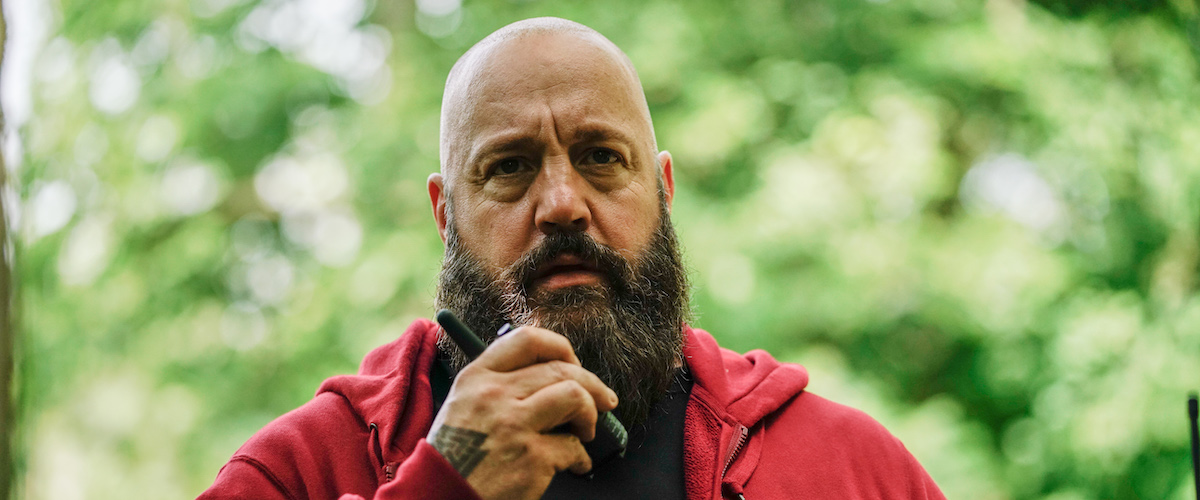
Mixing the worst elements of Desperate Hours and Home Alone, Becky is violent in a manner so over-the-top, it is almost challenging you to cry uncle.   A bad guy isn't just stabbed in the eye, his eyeball hangs perilously from the socket and has to be cut off with a knife.   In another instance, a villain isn't simply run over with a car, we are shown the guy's head being squashed repeatedly into the grass.    These unnecessarily gory flashes of violence are not entertaining, but sickening.   It doesn't matter much, because Becky has a protagonist we don't sympathize with and a plot we don't care about.  Comedian Kevin James is cast in "his first dramatic role" and he should have held out for something better.   Almost any other movie would qualify.

James is Dominick, a Neo-Nazi inmate who escapes with other inmates to track down a key located in the basement of a secluded home in the woods.   The home is now occupied by Becky (Wilson), an angry, cynical teen who lost her mother to cancer a year ago, and her understanding, patient father (McHale).   The two are joined by the dad's new fiancee (Brugel) and her young son (Rockcliffe). 
Becky, in a fit of rage after discovering her father is going to remarry, lights out for a tree fort in the adjacent woods which is almost as big as some single bedroom apartments.    She is not present when Dominick and his cohorts invade the home looking for the key.   What does the key unlock?   We aren't told, but it is quite important.   Who has it?   Becky, who came across it while rummaging downstairs in the basement.    Dominick was reportedly in prison for nine years.   His plan hinges on the unlikelihood that his key would still be stored away neatly in a small box on a window sill in a basement of someone else's home for nine years.   He should consider himself fortunate that the key and its accompanying box weren't dumped years ago and that Becky actually has it.

I don't know why Dominick had to made into a Neo-Nazi with multiple swastikas tattooed on his body, including a prominent one on the back of his bald head.    It is overkill.   He could have just as easily been written as a violent sociopath, minus the racist rants, looking for a key to a safety deposit box which houses riches to fund his escape.    James doesn't look comfortable reciting white supremacist philosophies.   The additional motivation wasn't needed.   While we're at it, Becky is written as far too bitter and a borderline sociopath herself to be someone we root for.   It's as if the villains conveniently came along just so Becky had someone to act out her pent-up aggression on.  And boy does she ever.  It is uncomfortable to watch a thirteen-year-old kill people so sadistically, even if it is the creepy bad guys.

Was Becky made for those who relish in blood, gore, and disturbing violence?   If so, then what about the rest of us?    I guess we can't fault the performances, which can't possibly transcend the muck going on here.   Wilson and James play the parts as written, although I still couldn't completely buy James as Dominick.   Maybe I'm simply too used to him playing lovable nice guys, which he should get back to doing as soon as possible if movies like Becky offer him the only opportunity to stretch his talents.